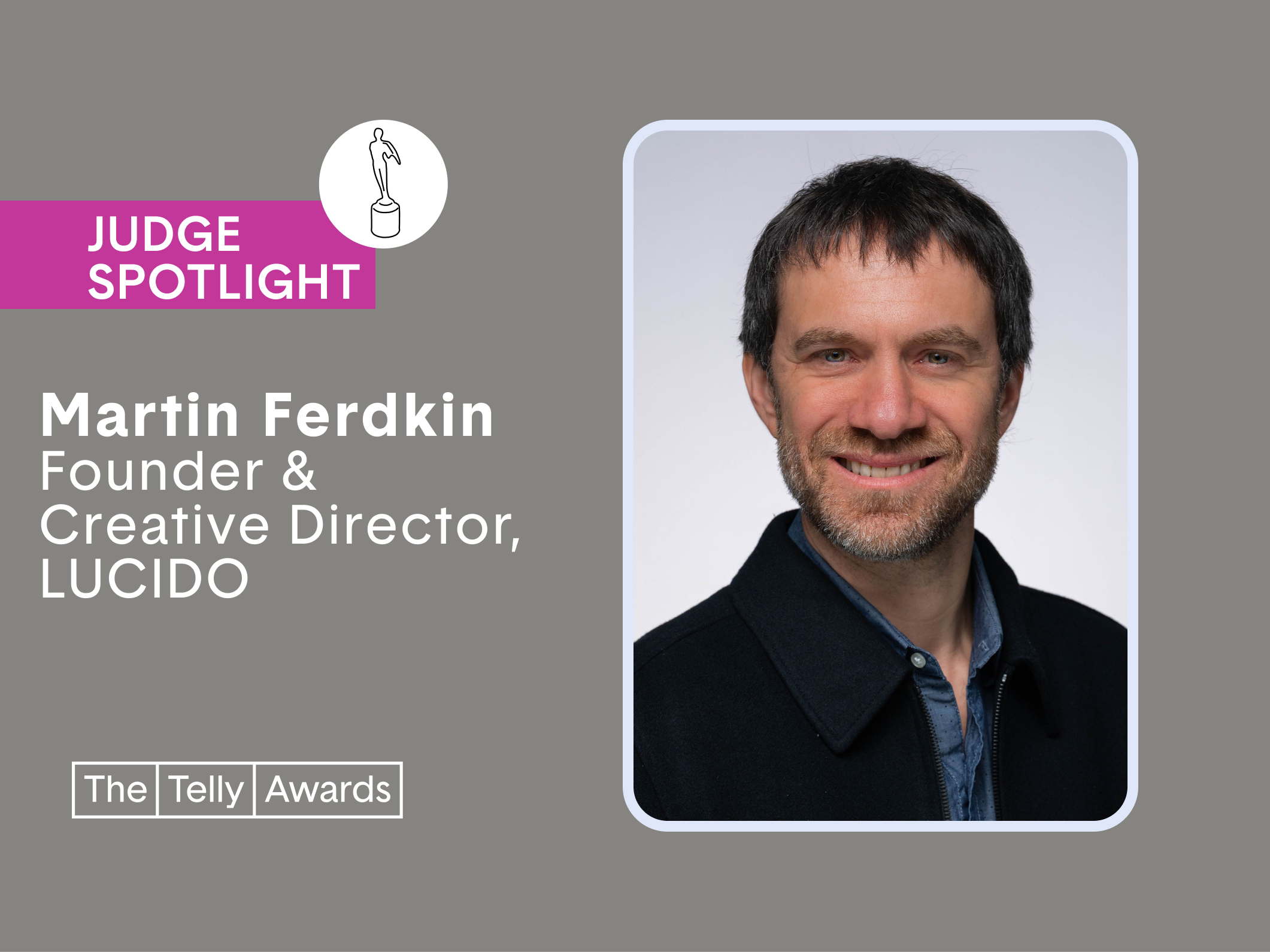
Martin Ferdkin is an award-winning Title Designer, 3D Motion Designer, and Creative Director with over 15 years of experience in visual storytelling for television, film, and digital media. He is the Founder and Creative Director of LUCIDO, a studio specializing in title sequences, animated branding, and high-end broadcast design.
His work blends narrative clarity, strong conceptual thinking, and refined execution, combining 2D and 3D techniques to create distinctive visual systems that elevate content and strengthen identity. Martin has collaborated with broadcasters and studios across Latin America, Europe, and the United States, and his work has been recognized by PromaxBDA, GEMA Awards, The Motion Awards, Creativepool, Bass Awards, and Collision Awards.
How many years have you been a judge?
This is my first year!
What excited you about judging for the Telly Awards?
The opportunity to step outside my own practice and evaluate work purely through the lens of craft, clarity, and impact. The Telly Awards bring together a wide spectrum of formats, cultures, and creative approaches, and I’m always inspired by the level of ambition and innovation happening globally. Judging is also a way of giving back to the industry that shaped me.
What was your first job in the industry? What did it teach you?
My first major role was as a Senior Motion Graphics Designer at TyC Sports in Argentina, where I worked for over seven years in a high-demand broadcast environment. Operating under tight deadlines and strict technical standards taught me discipline, adaptability, and precision. It also helped me discover the importance of pursuing what truly excited me despite constraints, and that creativity is what makes the difference, especially under pressure.
What project are you most proud to have worked on?
I’m especially proud of leading the TV commercial for Alkass Sports during the FIFA World Cup Qatar 2022. It was a high-pressure project on a truly global stage, where every detail mattered. Seeing the work perform at that level was incredibly rewarding, and receiving multiple awards and nominations for it made the achievement even more meaningful.
What’s the most challenging part about your job and/or the industry?
The pace of change. Technology, platforms, and audience behaviors evolve constantly. The challenge is staying adaptable without losing depth or intentionality. There’s a temptation toward speed and volume, but I believe the real value remains in thoughtful design and long-term visual systems.
What do you look for to determine excellence in video?
Clear intention, strong concept, cohesive storytelling, and refined execution. Craft in service of meaning.
What are your current roles and responsibilities and what do you love most about your job?
I’m the Founder and Creative Director of LUCIDO, where I lead title sequence design, animated branding systems, and broadcast graphics projects. My role spans concept development, visual direction, client strategy, and team leadership. What I love most is building visual worlds from the ground up and collaborating with talented artists to transform abstract ideas into living, moving systems.
What initiatives or projects are you working on now that excite you?
I’m particularly excited about developing premium broadcast systems for global sports and large-scale live events. Designing visual systems that must perform seamlessly across broadcast, social, localization, and live execution is a creative and technical challenge I truly enjoy. With the FIFA World Cup approaching, the opportunity to shape work at that scale feels especially meaningful to me, both professionally and personally, as a lifelong soccer fan.
Do you have any specific practices you lean on to spark creativity?
I spend time writing concepts before I start designing. If the idea is not strong in words, it will not be strong in motion. I am also deeply interested in fields beyond my immediate practice, such as cinema, architecture, typography, and music, which constantly influence how I think about rhythm, structure, and emotion. Limitation is another tool I rely on, since defining clear constraints often leads to stronger and more focused creative solutions.
What inspired you to pursue your career path?
I’ve always been fascinated by how moving images shape perception and emotion. Title sequences, in particular, felt like a powerful form of condensed storytelling, where typography, rhythm, sound, and narrative come together.
I was deeply inspired by Saul Bass and his iconic film titles. Later, discovering the title sequence of “Se7en”, and reading about its process in Communication Arts, was a turning point. That moment made me realize that graphic design could move, breathe, and tell stories, and I knew that was the path I wanted to follow.
In your experience, what is a significant change you are seeing happen in the video, television, and/or film industry, and what insight can you share about how to navigate it?
A major shift is the fragmentation of platforms and the need for visual systems that work seamlessly across broadcast, streaming, social, and live environments. The work is no longer a single deliverable but a flexible ecosystem.
At the same time, brands and individuals can now act as their own media channels, which means everything becomes content. My advice is to think in systems, not pieces, and to protect your authentic voice. Build identities that adapt across platforms without losing coherence.