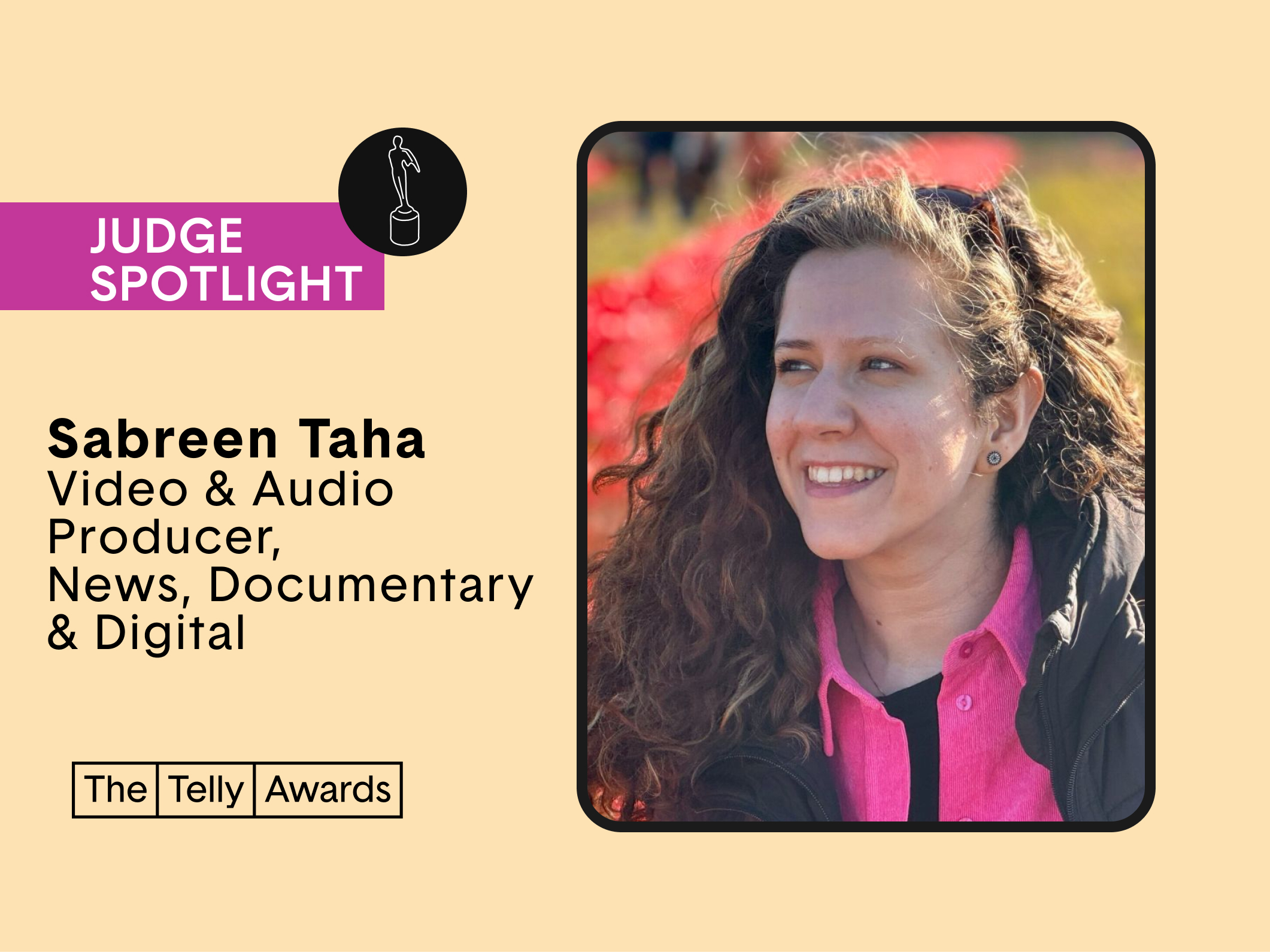
How many years have you been a judge?
This is my first year!
What excited you about judging for the Telly Awards?
Through the Telly Awards I’m really interested in the opportunity to engage with work from across different formats, regions, and perspectives. Being part of the judging process is a chance to step outside my own day-to-day work and look at storytelling more broadly, to see what’s evolving, what’s resonating, and how people are experimenting with form and narrative. I’m particularly curious to see how creators are finding new ways to tell meaningful stories, especially in spaces that aren’t always at the center of the industry.
What was your first job in the industry? What did it teach you?
My first job in the industry was with a small youth NGO, where I had the opportunity to present and produce a TV show. It taught me how to take ownership of a story from start to finish, often with limited resources, and how to think creatively under constraints. More importantly, it gave me an early understanding of storytelling, teamwork, and the importance of connecting with an audience in a clear and authentic way.
What project are you most proud to have worked on?
One project I’m especially proud of is The Judge, directed by Erika Cohn, where I worked as a field producer, handling logistics, access, interviews, and translation to and from Arabic over two years of filming, to help the team get the essential and main scenes and interviews they need for the documentary. The documentary follows Kholoud Al-Faqih, the first female judge in a Shari’a court in the Middle East, as she challenges a deeply patriarchal system. Being part of such an intimate and impactful story was incredibly meaningful, and the film went on to win a Peabody Award and receive an Emmy nomination.
What’s the most challenging part about your job and/or the industry?
One of the most challenging parts of my job is working in constant urgency and making fast editorial decisions while ensuring accuracy, context, and responsibility, especially on sensitive or complex stories. The industry itself is also shifting quickly, with increasing demands for speed, volume, and digital reach, which can sometimes come at the expense of depth. Balancing those while still producing thoughtful, meaningful work is an ongoing challenge in my opinion.
What do you look for to determine excellence in video?
First of all, I look to see what the piece is trying to say and how effectively it communicates it. Strong videos are purposeful in every choice, from structure and pacing to sound and visuals, with storytelling that feels honest, engaging, and simple. Editing, sound design, and visuals should feel seamless, and not over complicated. It should serve the story after all. I also value originality in perspective or execution, and ultimately, excellence is when a piece stays with you after you’re done seeing it.
What are your current roles and responsibilities and what do you love most about your job?
In my current role, I produce and oversee video content as part of daily news coverage, working across breaking news, U.S. politics, and international stories. My responsibilities include pitching and shaping stories, scripting, and ensuring fast, accurate delivery under tight deadlines. What I value most is working in a high-pressure newsroom where decisions matter in real time, and being able to turn complex, fast-moving events into clear, reliable stories that reach audiences around the world.
What initiatives or projects are you working on now that excite you?
Right now, I’m producing video content across breaking news, U.S. politics, and international stories, often in fast-paced, high-pressure environments. Alongside that, I’m also developing video content online, experimenting with more personal and narrative-driven storytelling. What excites me is being able to move between these two spaces; daily news production and independent content and finding new ways to tell stories that are both timely and more reflective, while connecting with audiences in different ways.
Do you have any specific practices you lean on to spark creativity?
I usually step away from what I’m working on and come back to it to see it from a different angle. I also rely a lot on observation, paying attention to small details, conversations, feedback and moments that might later shape an idea. Switching between formats helps too, so moving from news to more personal or visual work often resets how I think and approach a story.
What inspired you to pursue your career path?
I was born in Jerusalem, where I was constantly surrounded by stories, journalists, and storytellers. Growing up in that environment made storytelling feel like a natural way to understand the world around me, especially in a place where everyday life is shaped by history and ongoing events. That early exposure stayed with me and gradually turned into a career focused on telling stories that are both meaningful and reflective of real experiences.
In your experience, what is a significant change you are seeing happen in the video, television, and/or film industry, and what insight can you share about how to navigate it?
In my opinion, one of the most significant changes in the industry is the speed at which it is evolving. There’s a strong shift toward digital platforms and constant demand for content. Navigating this means being flexible, understanding both traditional storytelling and digital behavior, while still holding on to principles like clarity, accuracy, and strong narratives. The challenge is not just keeping up with the pace, but making sure the work remains thoughtful and intentional despite it.