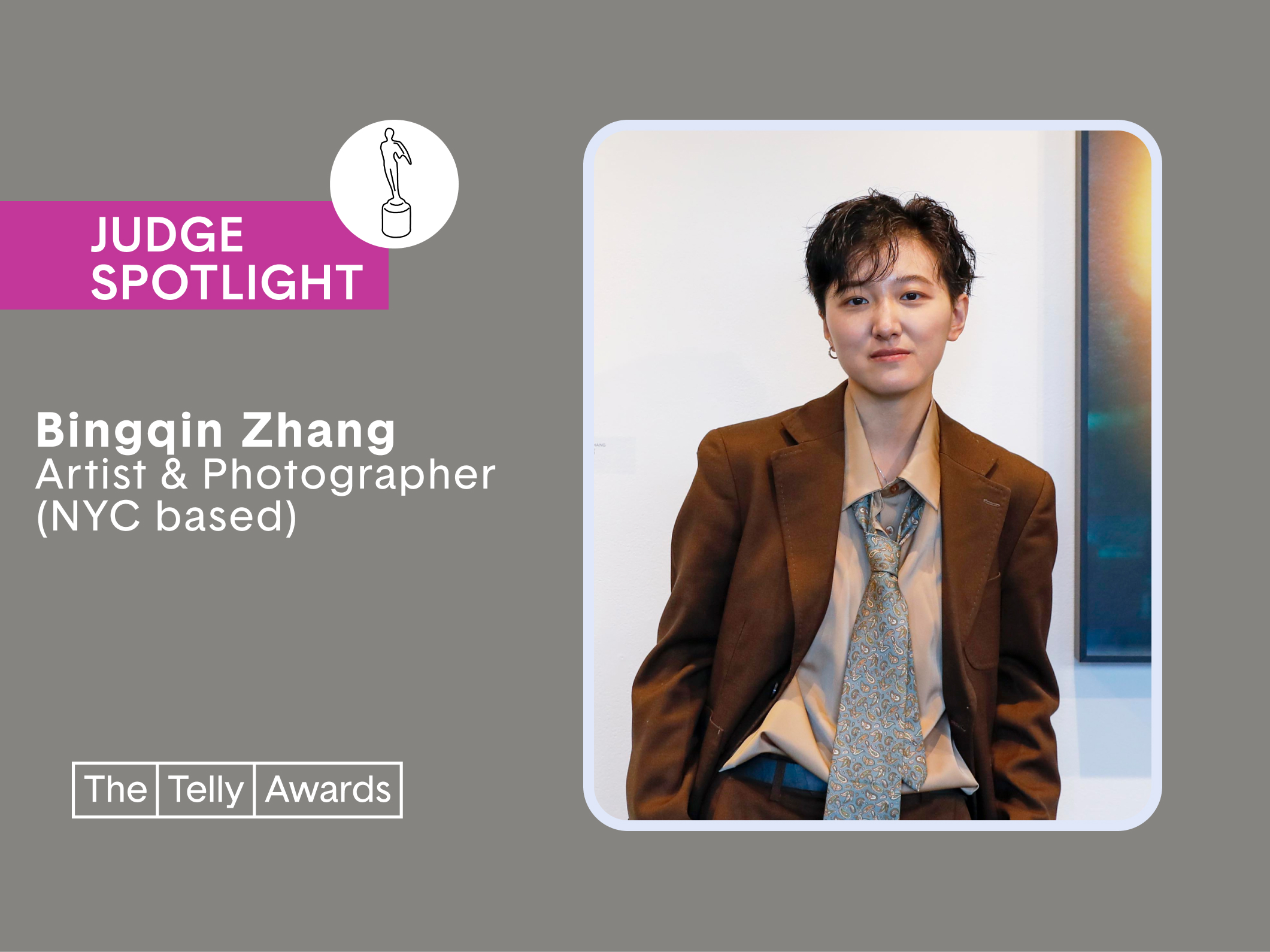
Bingqin (Zaccheo) Zhang is a NYC-based artist. Her works focus on the spiritual connection between the external world and individuals, striving to rejuvenate the photographic medium in modern art.
How many years have you been a judge?
1-3 years
What excited you about judging for the Telly Awards?
Being able to see outstanding industry works and be inspired by them is the most important reason I want to participate as a judge. I am very eager to see creative works and to have these works reach a wider audience. In a fast-paced information age, it’s easy to lose focus on content within seconds, and I hope to see works that can hold my attention—works that linger in my mind and make me think or reflect after viewing, and I believe that on a platform like the Telly Awards, you can see many such works.
What was your first job in the industry? What did it teach you?
Besides my internship at Harper’s Bazaar, my first job was as a freelance photographer. It’s a demanding career that requires mastering every step from concept to completion, and as a freelancer, you must maintain good relationships within the industry and know how to market yourself. This experience taught me a lot and has been immensely beneficial to my current role.
What project are you most proud to have worked on?
My MPS graduation short film is the project I’m most proud of. Even after nearly five years, I still feel proud of it. “I Don’t Remember” was born in a social environment where women’s safety is threatened and self-awareness is suppressed. Through this work, I hope to inspire women to unleash their potential and pursue inner peace.
At the same time, my MFA graduation piece, “One Kind of Touch,” uses experimental methods to explore the relationship between the artist and the medium, redefines the materials of art-making, and discusses the concept of photography as a container through sculpture. Because student works allow me to express my views on society and my own interests without external influence, I received a lot of help from artists during the creative process, which gives me a special feeling about these two works.
What’s the most challenging part about your job and/or the industry?
I believe what sets us apart is doing things differently from others. Many companies already have very mature advertising campaigns; producing a good piece isn’t the hardest part. The real challenge is differentiating the work and conveying the brand’s DNA.
What do you look for to determine excellence in video?
Regarding the judging criteria for videos, I decide based on the specifics of each case. For commercial/product-type videos, I place more emphasis on whether the product information is conveyed accurately and in an engaging way; for narrative-focused videos, I place greater emphasis on emotional expression and the transmission of values; for creative videos, I value the overall coherence and completeness of the video. There is no single standard for evaluating; I believe every submitted short film is excellent.
What are your current roles and responsibilities and what do you love most about your job?
I am currently the Creative Director at a well-known jewelry company, Christopehr Designs. My day-to-day work involves overseeing the company’s monthly visual projects, including videos and imagery, and sometimes involving animation and design-related tasks. Once the direction is set within our marketing team, I plan the involved personnel according to project deadlines, allocate tasks, contact agencies and various talents, determine locations, manage rights and licensing, and set the budget. During execution, I ensure the smooth progression of each stage and handle any ad hoc issues. In the post-production phase, I follow up on production progress and coordinate the payment process.
I love my job because my company gives me a ton of flexibility to pull together all the resources to get things done. I’m really into fast-paced environments too—the faster pace keeps my brain in overdrive so nothing slips through the cracks—and I’m always learning the latest tech and trends to make sure we’re delivering the best possible solution.
What initiatives or projects are you working on now that excite you?
The company I work for is preparing to shoot a jewelry-focused short film. I can’t disclose more details yet, but we will strive to elevate the level of detail captured in the jewelry to an industry-leading standard. The company’s cutting technology is top-notch and patented, I believe, as the marketing team, we have an obligation to showcase that. On a personal note, I have completed an article on AI and photography; a leading academic journal has expressed interest in publishing it, but it is still in the revision stage. I’m very happy about this healthy momentum between my work and my personal interests, and I hope I can maintain such enthusiasm going forward.
Do you have any specific practices you lean on to spark creativity?
I’m committed to learning and make it a weekly habit. It’s not about how much I learn each week, but about maintaining a sustainable practice. Whether it’s visiting exhibitions or watching videos, I make sure to absorb new knowledge every week. Browsing other photographers’ websites, attending art exhibitions, and learning editing techniques online are all avenues for learning—a cumulative process. You might not notice changes immediately, but there will come a time when it all clicks.
What inspired you to pursue your career path?
I grew up in Bagong House, which is a protected building now. Since childhood, my mother would take me to exhibition halls filled with artifacts, which at the time weren’t well protected, so I could get close to them. A child’s curiosity and desire to explore made me eager about these things. I believe my childhood experiences shaped a different way of seeing the world. Photography happens to be the means by which I can express how I view things; it’s a channel I use to communicate with the world.
In your experience, what is a significant change you are seeing happen in the video, television, and/or film industry, and what insight can you share about how to navigate it?
AI is the undeniable trend, with AI-produced videos and imagery already matching outputs from industrial-scale production. The key questions are whether AI will replace us, where our irreplaceable strengths lie, and how to leverage AI to accelerate my growth in the face of this irreversible shift.