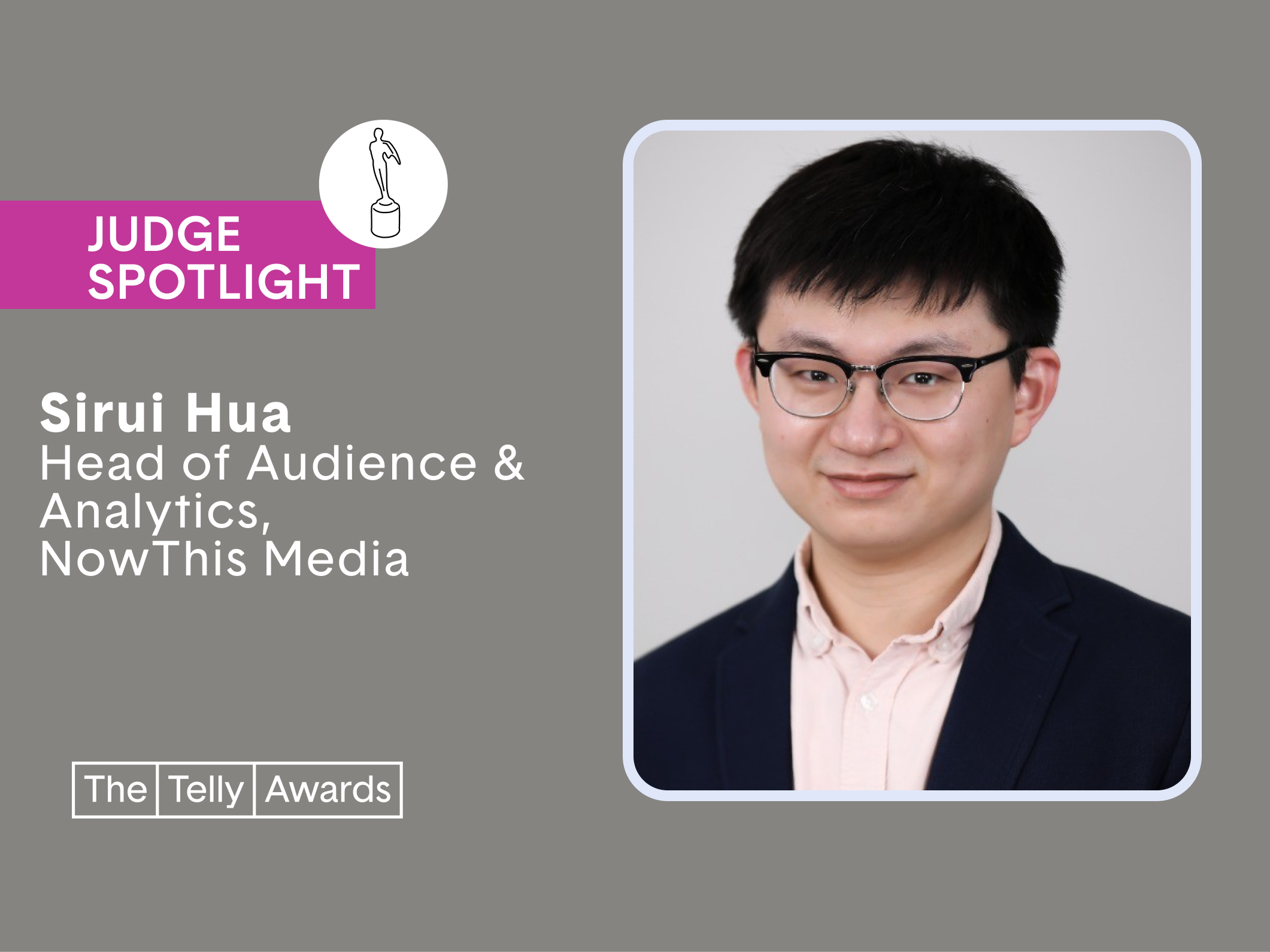
Sirui Hua is the Head of Audience & Analytics at NowThis, one of the top video publishers on social media. He leads the data strategy for a global video brand, bridging the gap between analytics and visual storytelling to drive engagement across platforms. A recognized expert in the digital video landscape, Sirui is a 2023 Webby Award winner for Social Events & Live Streams. He is also a trusted evaluator for the industry’s top honors, currently serving on the judging panels for The Webby Awards (IADAS), the Online News Association (ONA), and the AAJA Awards.
How many years have you been a judge?
This is my first year!
What excited you about judging for the Telly Awards?
As a data strategist, I usually see content through the lens of metrics and retention charts. Judging for the Tellys allows me to step back and appreciate the pure craft behind those numbers. I’m excited to discover work that doesn’t just perform well algorithmically, but achieves that performance through genuine, innovative visual storytelling that moves the industry forward.
What was your first job in the industry? What did it teach you?
I started as an Associate Producer. It taught me the rigorous mechanics of how to build a narrative arc, from the opening hook to the emotional payoff. Learning the human and creative side of production first was invaluable. Now, when I look at stats and charts, I don’t just see numbers or trends, I see the narrative beats. That early experience taught me that to tell great stories, you have to understand the human element behind the screen.
What project are you most proud to have worked on?
I am most proud of leading our audience strategy during NowThis’s transition as an independent entity after spinning off from Vox Media. Transitions of this magnitude are challenging, requiring us to rebuild systems and workflows from scratch while keeping the lights on. This experience gave me a holistic view of the business operation that I wouldn’t have gained otherwise. It taught me how to build resilience into our operations and gave me a deeper appreciation for how every department must interlock to create a sustainable business.
What’s the most challenging part about your job and/or the industry?
The biggest challenge is the velocity of the technological landscape. Media is often the ‘canary in the coal mine’—we are almost always the first industry to be disrupted by new tech, whether it’s the shift to mobile, algorithms, or now, Generative AI. The ground under our feet is always shifting, forcing us to constantly rethink how we create and distribute content.
However, that constant state of flux is exactly what makes this job so invigorating. It turns the industry into an intellectually stimulating puzzle where we can never get comfortable. This pressure forces us to reinvent our playbook and find new ways to connect with audiences before anyone else does.
What do you look for to determine excellence in video?
Excellence is defined by the ability to build a relationship with the viewer, which requires both authenticity and consistency. I look for videos that don’t just chase trends but adhere to a unique, recognizable style. When a creator is consistent in their delivery and authentic in their message, they transform a passive viewer into a loyal community member. That ability to command distinctiveness is what I consider excellence.
What are your current roles and responsibilities and what do you love most about your job?
As the Head of Audience & Analytics, I operate right at the intersection of art and science. My responsibility is to translate complex data into actionable strategies that drive our content forward. What I love most is the scrappy, startup culture of our team. It gives me a tremendous amount of agency to pilot new projects that can support building sustainable media business models from the ground up. There is nothing more rewarding than using data to empower our creators, giving them the freedom to tell better stories while ensuring their work finds the audience it deserves.
What initiatives or projects are you working on now that excite you?
I am currently developing internal agentic AI tools that function as data analysts and strategists. These agents can autonomously query complex datasets, surface key insights, and even queue up strategic actions. The system is built on a ‘human-in-the-loop’ architecture, where the AI does the heavy computational lifting, but a human expert always confirms the final decision. It’s shifting our team from spending time on data extraction to focusing on strategic execution, significantly expanding our ability to support the operation of the company and its creators.
Do you have any specific practices you lean on to spark creativity?
My go-to practice is long-distance running. Living in Jersey City, I have a routine of running along the Hudson River waterfront. There is something about the rhythmic physical exertion that clears mental clutter. With the Statue of Liberty and the Manhattan skyline as my backdrop, I find that stepping away from the screen and looking at that expansive view is often where my best ideas surface.
What inspired you to pursue your career path?
I have always been driven by the intellectual challenge of solving complex problems, but I wanted to apply that to something human. I realized early on that in the digital age, even the most brilliant stories can get lost without the right strategy. My inspiration came from a desire to become the infrastructure that supports creators. I wanted to take on the burden of decoding algorithms and analyzing trends so that storytellers can focus on creating magic, knowing that there is a system in place to ensure their work finds its audience.
In your experience, what is a significant change you are seeing happen in the video, television, and/or film industry, and what insight can you share about how to navigate it?
We are witnessing a crisis in how content is monetized as linear TV models decline. The challenge is that as budgets shrink, it becomes harder for creators to sustain their craft.
My hope is that Generative AI offers a path forward by democratizing production value. It allows individual creators to achieve cinematic results—whether it’s advanced VFX or complex editing—at a fraction of the cost. To navigate this industry shift, we shouldn’t fear these tools but leverage them to do more with less. AI can bridge the gap, allowing creators to maintain high artistic standards and build sustainable careers even as the traditional industry contracts.