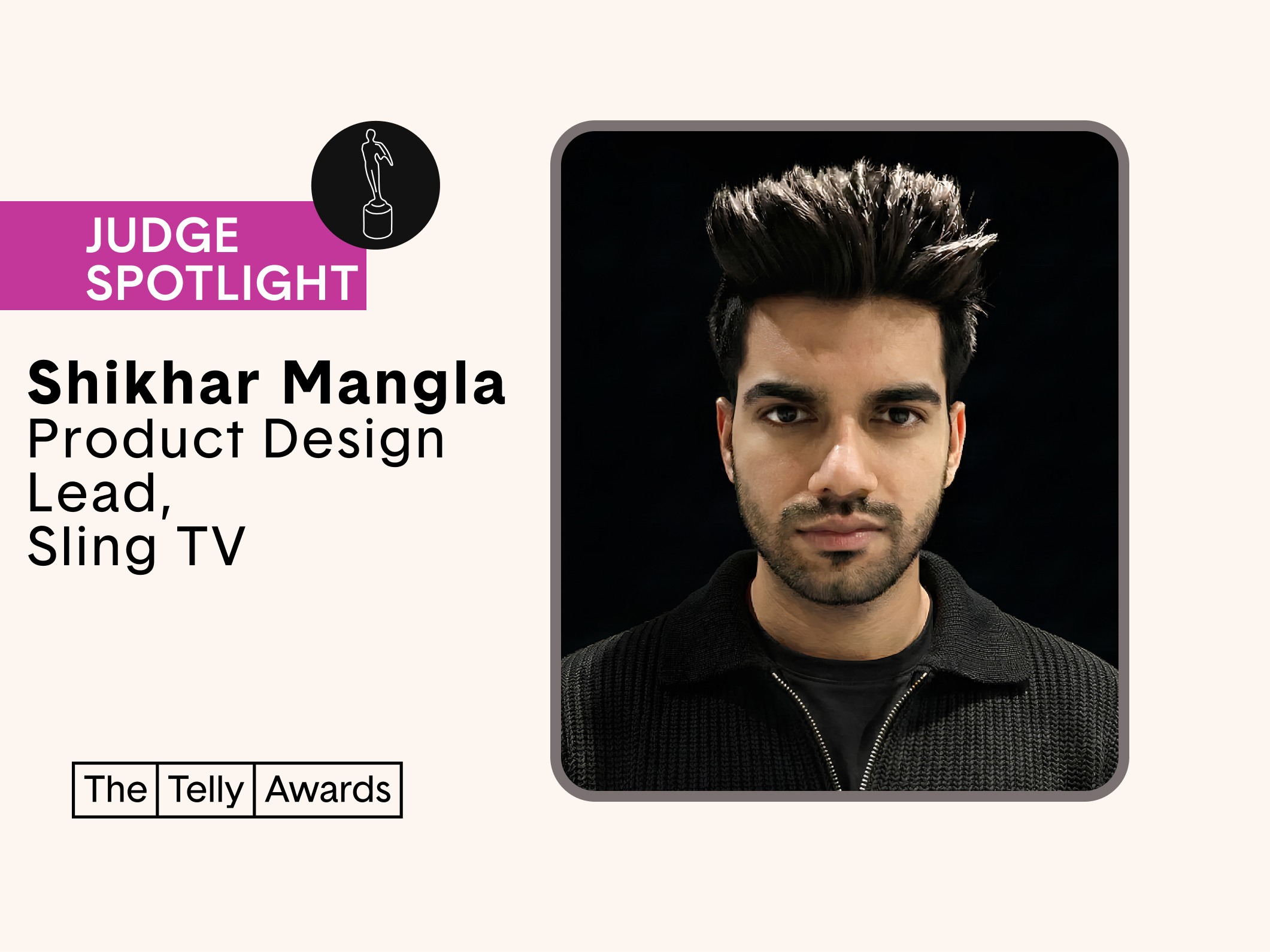
Shikhar Mangla is a Product Design Lead at Sling TV, where he designs consumer-facing experiences across TV, mobile, and web for streaming, discovery, and content engagement. He’s worked across a range of consumer products and partnered with Fortune 500 brands, with a focus on clarity, usability, and high-quality interaction design. His work has also supported responsible gambling initiatives at scale and digital experiences that help make public information more accessible and transparent. He enjoys building thoughtful, accessible experiences that balance craft with real-world constraints.
How many years have you been a judge?
This is my first year!
What excited you about judging for the Telly Awards?
I love that the Telly Awards sits at the intersection of storytelling and craft, where strong ideas still need excellent execution to land. I’m excited to help recognize work that respects the audience’s time, makes smart creative choices, and delivers a polished experience across platforms.
What was your first job in the industry? What did it teach you?
My first job in the industry was designing a mobile app for a prominent Chief Minister in India. The goal was to help constituents stay updated on what was happening in the constituency and submit grievances directly. That experience taught me that good UX in public-facing products is about dignity and reliability as much as it is about visuals. When people are looking for help, the interface has to be calm, clear, and frictionless
What project are you most proud to have worked on?
I’m most proud of the work I did on responsible gambling experiences at scale. Designing for that space meant balancing business goals with real user safety, using clear language, friction in the right places, and thoughtful guardrails that help people make better decisions in the moment. Knowing the work supported responsible play for millions of bettors across the U.S. is the kind of real-world impact I care about most.
What’s the most challenging part about your job and/or the industry?
The hardest part is balancing speed with quality in an environment where platforms, expectations, and content formats keep shifting. Great work requires craft, but it also requires strong judgment about what matters most – so you don’t over-design the wrong thing while the real problem remains unsolved.
What do you look for to determine excellence in video?
I look for clarity of intent first: what is this trying to make me feel, do, or understand, and does every choice support that? Then I look at pacing, structure, and detail in execution like editing, sound, performance, and visual consistency – because those are usually what separate “good” from “great.” I also pay attention to accessibility and audience context, especially for content designed for different screens and environments.
What are your current roles and responsibilities and what do you love most about your job?
I lead product design for consumer digital experiences, partnering with product, engineering, research, and content teams to ship end-to-end features across TV, mobile, and web. What I enjoy most is turning messy, ambiguous problems into something simple and confident, where the experience feels obvious in hindsight, even if it wasn’t obvious to build.
Do you have any specific practices you lean on to spark creativity?
I start with constraints on purpose: a tight problem statement, a clear success metric, and a few “must nots” that keep the work honest. Then I explore widely and come back to a small set of options, pressure-testing each one with “What’s the simplest version that still feels premium?” That rhythm keeps me creative without drifting.
What inspired you to pursue your career path?
I’ve always been drawn to the combination of craft and systems – where design is both a creative discipline and a way to solve complex problems for real people. Product design let me work at that intersection: storytelling, usability, technology, and impact, all in one place.
In your experience, what is a significant change you are seeing happen in the video, television, and/or film industry, and what insight can you share about how to navigate it?
Distribution has fragmented and attention has tightened, which means the “first 10 seconds” matter more than ever, but so does long-term trust. The best way to navigate it is to be intentional: earn attention with clarity and authenticity, design for the platform context, and maintain a consistent creative point of view instead of chasing every trend.