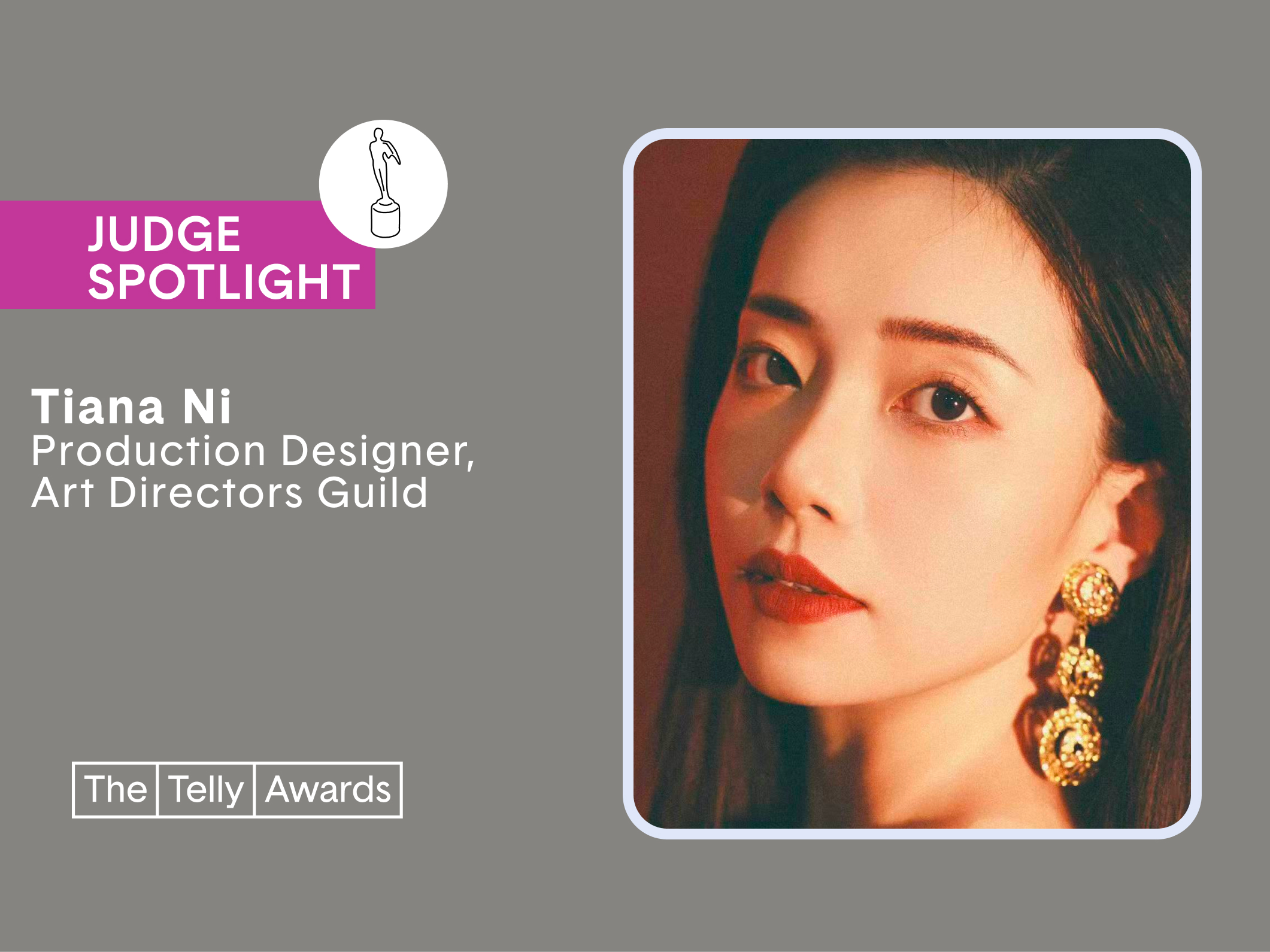
Tiana Ni is a Chinese production designer working across Beijing, Hongkong and Los Angeles. She graduated from Emerson College holding an MFA degree in Film and Media Art.
Her works ranges from feature films, TV series, music video and commercials. Some of her recent works include All Tomorrow’s Parties, which was selected for the 73rd Berlin International film festival and screened in Hong Kong International Film Festival. My Old Pal, which awarded by Golden Rooster film festival.
She is a member of ADG (Art Directors Guild) and BAFA (Busan Asian Film Academy). She also got selected for ‘Berlinale Talents’ 2024. Her visual approaches extend to VFX and AI, embraces multiple techniques to explore visual design.
How many years have you been a judge?
1-3 years
What excited you about judging for the Telly Awards?
It gives me the opportunity to view work by talents from different regions, and it is also an important learning process for me.
What was your first job in the industry? What did it teach you?
My first job was as a Production Assistant on a TV project at a large studio. My main responsibility was researching and collecting references on the story’s background, providing the design team with enough historical materials and visual resources to support their work.
This experience made me realize that we design sets and film stories to create a sense of authenticity for the audience. But creativity doesn’t come out of thin air—it needs to be grounded in something real.
What project are you most proud to have worked on?
Not yet—but every year there are ideas I’m still not ready to execute. That’s also what keeps me moving: I’m constantly testing the edges of my imagination, growing through the process of making.
One project that stays with me is a music video for a prominent singer. On a soundstage, we built a period forest and a house from the ground up. I was thrilled then, and I still value the experience—but with new eyes, I can see how much further I could push it today.
What’s the most challenging part about your job and/or the industry?
I think the most fascinating part of my job is also the most challenging: uncertainty and uniqueness. Every brief is new, and some take me into unfamiliar territory I’ve never worked in before. That unknown can be intimidating, but also exciting for any designer.
The design process is also a process of learning—especially when I’m creating environments rooted in cultures outside my own. You have to understand, as quickly as possible, what makes it feel real and believable, rather than artificial.
What do you look for to determine excellence in video?
The ability to visualize—transforming words and ideas into audiovisual language that endures and resonates.
What are your current roles and responsibilities and what do you love most about your job?
My role is to design the visual spaces and sets seen on camera—scenes, stages, and environments—and to use objects and spatial design to convey emotion and tell a story.
What I love most is the uncertainty: every project and case is unique, with different needs, so I’m always designing something new. It keeps the work fresh and never feels boring.
What initiatives or projects are you working on now that excite you?
Recently, I’ve been working on an experimental short film that combines AI-generated imagery with live-action footage. In a way, AI has freed my imagination—I can set budget constraints aside and use AI to help realize ideas that would otherwise have to be abandoned due to cost.
Do you have any specific practices you lean on to spark creativity?
I always keep a notebook to jot down ideas. When something catches my eye or a thought flashes through my mind in everyday life, I’ll record it with my phone or camera. Inspiration is always fleeting.
What inspired you to pursue your career path?
I enjoy traveling, but not as travel for its own sake. My work gives me opportunities to visit different cities and countries and to learn about local contexts and the way people live. I also get to observe how architecture and streetscapes shift from place to place. I love the freshness and sense of adventure that comes from a project or shoot taking me somewhere unfamiliar.
In your experience, what is a significant change you are seeing happen in the video, television, and/or film industry, and what insight can you share about how to navigate it?
I think audiences have become more open to different kinds of video imagery. We used to assume landscape was the default, but now more and more people choose vertical formats. For storytelling and creative work, a change in aspect ratio also changes the language of how you frame, pace, and communicate.
At the same time, AI is accelerating this shift. Many people are anxious about whether AI will replace us or take over the whole process. We’re living through a moment of rapid change, and as I learn and work with these tools, I’ve realized it’s also a process of understanding what I truly want to make.