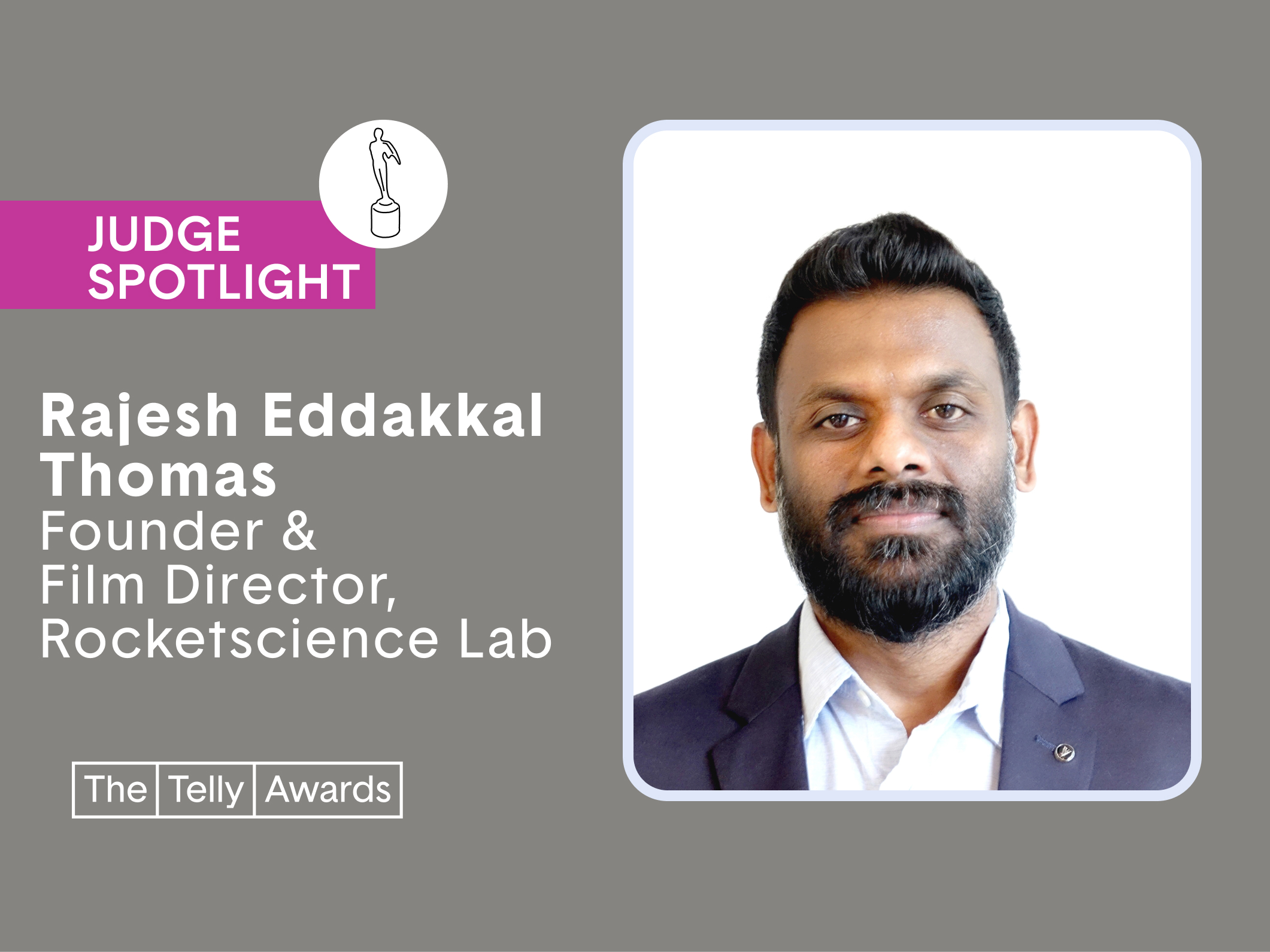
Distinguished ad film director Rajesh Thomas, specializes in commercials and digital films. Renowned for his sharp eye for detail and storytelling, his videos artfully playout his obsession with art and
technology. Rajesh’s work is a vibrant blend of live-action, CGI, VFX, Animation, Miniatures & Stop-motion celebrated for its seamless fusion of creativity and innovation. His works have won multiple awards and have been showcased in various international magazines and festivals around the globe. His work for Amazon won the prestigious Dada Saheb Phalke Film Festival award for the best ad film. With over 14 years of experience, Rajesh has cultivated an experimental flair that boasts an impressive portfolio and an equally outstanding reputation. His work has gained recognition at prestigious platforms such as Fastcodesign, BBC Music Video Festival, One Screen, London International Animation Festival, East End London Film Festival and Holland Animation Film Festival. His work has been featured in publications and websites, including Stash, Best of Stash, Stash permanent Collection, IDN, Computer Arts (D&AD article), Promonews, Bloody Loud, Desktop, File, Hugo Boss, and The Creators Project, among others. He been a member of the Telly awards and Muse Awards judging council. He consistently delivers beautifully crafted, intelligent work while maintaining a distinctive style. He dwells between both traditional and emerging mediums, with a strong emphasis on original content. From commercials, product films, music videos to idents he continues to design groundbreaking moving-image works that push the boundaries of creativity.
How many years have you been a judge?
5+ years
What excited you about judging for the Telly Awards?
What excites me about judging for the Telly Awards is seeing how creativity in advertising and video keeps evolving. Every year, the entries bring fresh perspectives, new storytelling styles, and innovative production approaches it’s inspiring to witness how the industry keeps redefining itself.
What was your first job in the industry? What did it teach you?
I started my career way back as a Visualiser in an ad agency. That role was my first real exposure to the power of storytelling through imagery. It taught me that visuals are not just about aesthetics they have the ability to shift perceptions, spark change, and open up unexplored possibilities. That early experience shaped the way I approach film today, always looking for ways to tell stories that are both impactful and original.
What project are you most proud to have worked on?
One project I’m especially proud of is a film I worked on for Amazon Karigar. It was creatively ambitious, combining miniatures, live action people shot on chroma, and extensive compositing to seamlessly bring everything together. The process was intricate and demanding, but also incredibly rewarding. I had a great time working on it, and it stands out as a project where the craft and storytelling came together beautifully.
What’s the most challenging part about your job and/or the industry?
The most challenging part of my job is actually signing a project. The industry is highly competitive, and winning a pitch often depends on striking the right balance between creative treatment and cost. Sometimes our treatment is strong, but the budget doesn’t align with the client’s expectations. Other times the cost may be competitive, but another director’s treatment resonates more powerfully. Navigating this balance between creativity, vision, and practicality is always the toughest part of the process.
What do you look for to determine excellence in video?
For me, excellence in video and television comes down to two things: content and execution. The first time I watch anything, I focus entirely on the content and story whether it engages me, moves me, or offers something fresh. The second time, I shift my attention to the craft and execution: how well the visuals, performances, editing, and overall treatment bring that story to life. True excellence is when both layers story and execution work seamlessly together.
How do you unwind from work mode?
To unwind from work mode, I often turn to experimentation it could be anything from trying out stop motion, to doing a quick shoot, or playing around with 3D in Blender. Exploring without pressure keeps me creatively refreshed. I also love traveling, which gives me new perspectives, inspiration, and the space to recharge.
Do you have any specific practices you lean on to fuel your creativity?
I draw a lot of creative energy from platforms like Stashmedia, Shots, Behance, and other creative feeds that showcase inspiring work from around the world. They push me to keep experimenting with new stories and fresh approaches to execution. Beyond that, I actively try out ideas through short film scripts, music videos, or any format that has the potential to move and entertain an audience. These explorations keep my creativity alive and evolving.
When did you know that this career is what you wanted to do?
Both my wife and I started out as art directors in advertising agencies. At one point, she decided to leave advertising and explore a career as a music video director. A few months later, I joined her on that path, and together we transitioned into creating advertising films for a living. Along the way, we experimented with a wide range of execution styles from stop motion, 2D and 3D animation, to mixed media and live action. That period of exploration confirmed for me that this was the career I wanted to pursue a space where creativity, storytelling, and craft could constantly evolve.
What inspired you to join the field and create the kind of work you do?
I’ve always been inspired by filmmakers like Wes Anderson, Tim Burton, Johnny Kelly, and Greta Gerwig the way they take simple stories and elevate them through unique execution. Their work showed me that it’s not always about complexity, but about clarity, style, and emotional impact. That continues to drive me today. I’m still trying every day to create something simple yet meaningful, and to make an impact through the way a story is brought to life.
In your experience, what is a significant change happening in the video and television industry, and what insight can you share about how to navigate it?
One of the biggest changes I’ve seen in the video and television industry is the impact of AI. Earlier, a lot of effort went into crafting execution styles that would grab attention. Now, with the AI boom, almost any style can be replicated it can feel like something your next door neighbour has already tried. This makes story and content more important than ever they are what truly make something an eye stopper. At the same time, clients are experimenting heavily with AI to create everyday content for their feeds. But I believe once audiences reach a saturation point with AI generated work, clients may shift back to valuing more organic, handcrafted storytelling. My insight is to go with the flow. Embrace the tools, adapt to the changes, but never lose focus on the story because that’s the one element that will always set a film apart.
What’s a work tool you use every day and what’s one that is obsolete that you wish still existed?
Adobe Creative Cloud is a tool I rely on every day. I keep it handy even when I’m traveling, as it’s essential to my workflow. One tool I really miss, though, is Macromedia FreeHand, which I used a lot while growing as a graphic designer. It may be obsolete now, but it had a charm and simplicity I still think about fondly.
What are your current roles and responsibilities and what do you love most about your job?
My current role is in advertising film direction and production. I work closely with different agencies, which gives me the opportunity to collaborate on a wide variety of briefs and scripts. Each project comes with its own unique challenges, and I see every film as a labour of love.
What I love most about my job is the process of bringing an idea to life from interpreting the script, to navigating production challenges, to finally seeing the film executed with impact. The diversity of projects keeps me inspired, and the constant problem solving pushes me to grow creatively and technically with every new film.
What initiatives or projects are you working on now that excite you?
Right now, I’m working on a series of product films for a brand that requires the involvement of multiple studios and artists. Unlike a one day shoot, these 3D projects can stretch over several months, demanding constant collaboration and fine-tuning. It’s both exciting and exhausting, exciting because of the creativity and scale of the work, and tiring because the process can be long and meticulous if the output isn’t aligning with the vision. Still, I enjoy the challenge of pushing through those moments to finally bring the film to life the way it was imagined.
Do you have any specific practices you lean on to spark creativity?
I constantly experiment with different forms of storytelling it could be through a small toy, a simple stop motion piece, or shoot a small clips with friends and family, 3D, or any other medium. I also love revisiting old advertising archives, library books, and classic DVDs from the early days they often spark fresh ideas and remind me how timeless creativity can be
What inspired you to pursue your career path?
I was always fascinated by magazine layouts the way large images or collages could tell a story without movement. I loved the use of empty space, the elegance of typography, and how every visual element carried meaning. I’d spend time studying bold billboards and their strong, simple messages. From there, my curiosity grew toward cinema and storytelling, and eventually, I fell in love with the art of short-form storytelling in advertising.
In your experience, what is a significant change you are seeing happen in the video, television, and/or film industry, and what insight can you share about how to navigate it?
The industry keeps evolving in cycles. Sometimes advertising becomes very direct showing the product upfront and other times it shifts toward cinematic storytelling. There are phases where execution style and visual craft take the lead, which is where we are right now. But I feel this phase will eventually reach saturation, and we’ll see a return to strong storytelling and classic filmmaking where emotion and narrative once again take center stage.