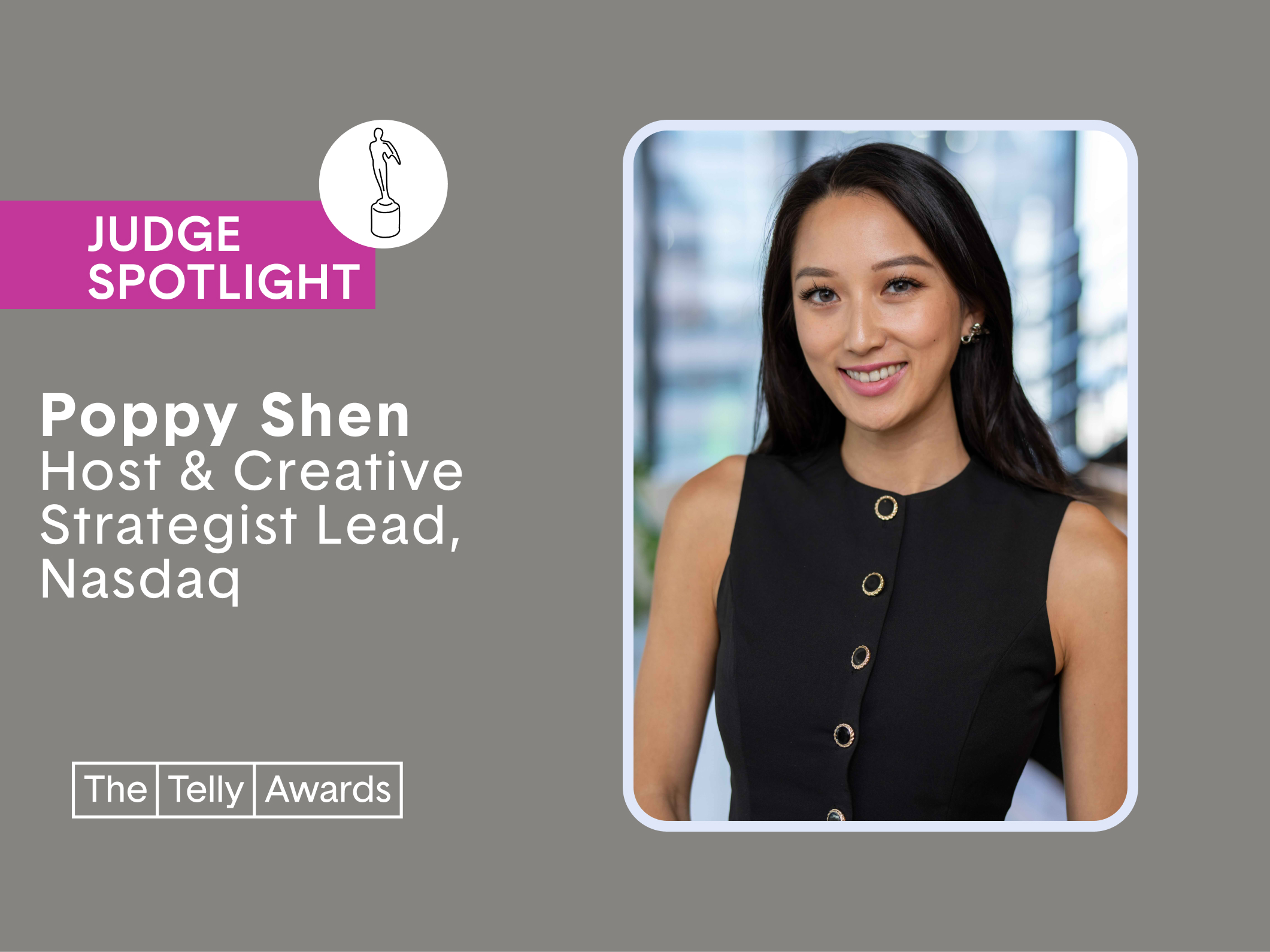
Poppy Shen is the Creative Strategist Lead at Nasdaq, and the Host and Producer of The Winning Formula series, where she convenes notable voices in sports to spotlight topics at the intersection of business and sports. Previously at CNN, Yahoo, and AOL, she is a creative leader and storyteller whose work spans business, sports, and the AAPI community, connecting brands with global audiences through authentic, cross-platform storytelling.
How many years have you been a judge?
This is my first year!
What excited you about judging for the Telly Awards?
I’m excited about the opportunity to champion creative voices who are pushing boundaries of video storytelling. I’ve spent the majority of my career at the intersection of journalism, marketing and branded content, so I love seeing how other creators and agencies use the medium to connect with audiences and move culture forward.
What was your first job in the industry? What did it teach you?
My first job in the industry was an internship on CNN’s Social Publishing team. I worked as a producer and editor for its social-first video series called ‘The Good Stuff’ where I created short-form, human-interest documentaries that aim to uplift our community and audience.
I learned the foundation of social-first video storytelling — grabbing attention in the first few seconds, creating cuts that resonate with different platforms, and making a story land in under five minutes. I also got to experience the editorial rigor of a serious newsroom: the fact checking, the layered approval process and the commitment to journalistic integrity that shapes every story that’s being told.
What’s the most challenging part about your job and/or the industry?
One of the biggest challenges is keeping up with how quickly audiences and platforms are evolving in a world where attention feels fragmented and algorithms are constantly changing. Because of that, the hardest part for most brands isn’t actually making the content, it is understanding who they’re talking to and how those audiences are changing in real time.
What do you look for to determine excellence in video?
Intent, innovation, and authenticity
What are your current roles and responsibilities and what do you love most about your job?
I’m currently the Creative Strategist Lead at Nasdaq, where I work on creative ideation and execution for Nasdaq’s key content initiatives including brand storytelling, video franchises, enterprise events and branded content campaigns. In addition, I’m also the Host & Producer of The Winning Formula, Nasdaq’s interview series that bridges the world of business and sports.
What I love the most about my job is the ability to be creative, experiment, innovate, and craft narratives that resonate with different audiences. I also love being able to connect with high‑profile athletes and leaders and hearing their stories firsthand and translating their experiences into insights that speak to both business and sports audiences. Being able to sit at the intersection of the two worlds, and bring them together in a way that feels human and accessible, is something that excites me every day.
Do you have any specific practices you lean on to spark creativity?
Traveling and immersing myself in different cultures is the biggest catalyst for my creativity. Taking myself out of a corporate environment — or even my everyday life — and hearing perspectives far outside my own, helps me reset how I see the world and broaden my creativity.
I also make a conscious effort to consume news and content beyond my usual orbit —international reporting, creators from other parts of the world, global sports coverage. Engaging with stories told through different cultural lenses pushes me to stay open and form my own unique point of view.
What inspired you to pursue your career path?
I was born in China and moved to the U.S. when I was 15. Having lived in different countries and cultures, I’ve always leaned on storytelling — especially visual storytelling — as a vehicle to connect with people, build empathy and make sense of the world around me.
In your experience, what is a significant change you are seeing happen in the video, television, and/or film industry, and what insight can you share about how to navigate it?
The adoption of AI is the biggest shift I’m seeing in production and creative processes, especially in the corporate marketing space. While its impact on productivity is undeniable, most people would agree that the real challenge is how we can stay authentic, ethical, and human in a time when it feels easier to automate outputs than relying on our instincts.
I use AI in many parts of my creative practice, but I always try to be disciplined about leaning on my own perspectives and instincts, and using AI for research, information gathering, and spotting blind spots I might not see on my own. As these tools get more advanced, I think the most important thing is holding onto the parts that make storytelling feel human.