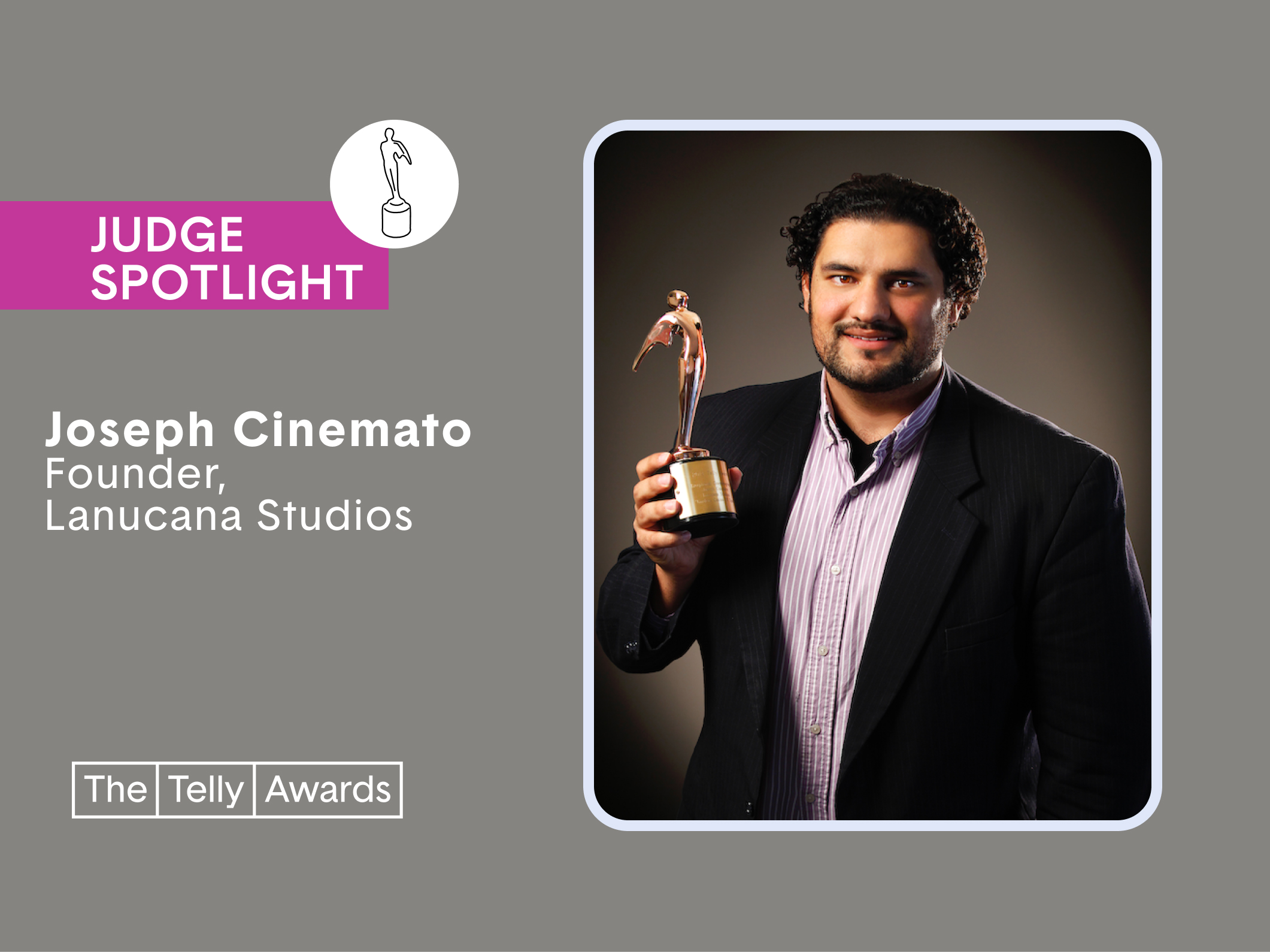
Joseph Cinemato, is a 2x EMMY Award nominated filmmaker and winner of 15 TELLY Awards. He holds a Master’s Degree in Business Administration (MBA), and is the founder of Lanucana Studios. Joseph’s work has been in dozens of International Film Festivals, won numerous awards, and in theaters nationwide. Some of his work has included ABC / Disney, Netflix, Amazon Prime, HGTV, the US Army, National Institute of Health (NIH), and Alex Hormozi.
How many years have you been a judge?
5+ years
What excited you about judging for the Telly Awards?
What excited me most about being invited in 2018 to join the Judges Council for the Telly Awards was the honor of being counted among peers at the highest level of the industry, and being entrusted with the detailed and thoughtful task of helping select future winners of these esteemed awards. Winning a Telly is an extraordinary achievement, and being given the responsibility to help recognize that level of excellence is a role I hold in the highest regard.
What was your first job in the industry? What did it teach you?
Answering what my first job in the industry was is a little tricky because I started out freelancing and creating my own independent projects. I took any work that came my way. One week I might be a Producer, the next a Cinematographer, and the following week a Grip.
What it taught me, however, is much easier to answer: the importance of relationships and flexibility. I learned the power of saying ‘yes’ and how the willingness to jump in and help can take you a long way. In fact, my very first union job came from one of those moments. I said ‘yes’ to helping a cinematographer I didn’t know, even though it was inconvenient for me at the time. Unbeknownst to me, she was a member of Local 600. She was so moved by my support that she later hired me to work alongside her union crew on several projects shortly thereafter.
So the lasting lesson for me has been to always stay willing to jump in, help where I can, and trust that generosity and hard work have a way of coming back around.
What project are you most proud to have worked on?
The projects I am most excited about right now are ones I have been developing for a few years and am now finalizing deals for. They include a scripted feature film, a scripted television series, and two limited docu-series.
An initiative that I am particularly proud and excited about is that my company and I have signed on as a sponsor for the Institute and Museum of California Art at the University of California, Irvine.
What’s the most challenging part about your job and/or the industry?
The most challenging part of both the industry and my job is the unpredictable nature of it. There are many different career paths in this field, but if you choose the freelance or entrepreneurial route, it can be a real rollercoaster. So make sure you’re buckled up for the ride!
What do you look for to determine excellence in video?
What I look for to determine excellence in video depends greatly on the category I’m judging, but the starting point is always technical professionalism. Using that as a baseline, I then focus on the artistry of storytelling. Whether I’m evaluating cinematography, directing, or another aspect, I ask myself: How does this contribute to telling a compelling story? Does it break or maintain immersion? I also look for a standout component, something that elevates the piece beyond being simply good or professional, into something truly excellent, truly TELLY-worthy.
What are your current roles and responsibilities and what do you love most about your job?
As the CEO of a media production company, my roles shift constantly, ranging from Director and Producer to Executive Producer, Writer, Cinematographer, and even Sales. Our work spans both agency and commercial projects, as well as feature films and television.
What I love most about my job is the opportunity to empower and collaborate with incredible artists and storytellers, helping them do what they do best. I also find great fulfillment in mentoring and training emerging filmmakers and artists, both within my company and throughout the creative community.
What initiatives or projects are you working on now that excite you?
The projects I am most excited about right now I have been developing for many years and am finalizing deals for at the same time. They include a scripted Feature Film, scripted TV Series, and 2 limited Docu-Series. An initiative that I am particularly excited and proud about is that myself and my company have come on as a sponsor for the Institute and Museum of California Art at the University of California Irvine.
Do you have any specific practices you lean on to spark creativity?
A few practices I lean on to spark creativity go all the way back to my early career and include building momentum and using selective caffeine.
If I’m having a hard time getting into the process, I just start. Even if what I’m creating at first might be terrible, the rule is that I’m not allowed to stop. No matter what! By starting and keeping the flow going, you force your brain into a creative rhythm, and before long, quality ideas begin to spark. This was a practice shared with me by an accomplished WGA writer early in my career, and it has stuck with me ever since.
Another technique is selectively dosing coffee and caffeine. My first cup of coffee ever was on the set of a low-budget, long-hour feature film early in my career. That first cup quickly turned into two pots a day before we wrapped. These days, I rarely consume caffeine so that when I do need to focus deeply, I can use a small dose of coffee and it actually works. It might sound funny to some, but you’d be surprised how much creative energy you can unlock by strategically micro-dosing coffee.
What inspired you to pursue your career path?
What inspired me to pursue this career was witnessing the power and impact that storytelling can have on people. Creating something and then seeing an audience react to your work leaves a lasting impression. There is something incredibly moving about realizing that a story you helped bring to life can make someone feel, think, or see the world a little differently. That connection between the creator and the audience is what continues to inspire me every day.
In your experience, what is a significant change you are seeing happen in the video, television, and/or film industry, and what insight can you share about how to navigate it?
The most obvious change happening in the industry right now is the rise of AI in the general marketplace. I encourage people not to feel overwhelmed by it, because what makes art truly meaningful is its humanity. While a machine may be able to produce beautiful images, people ultimately crave the human touch.
We are already seeing a growing resurgence of ‘vintage’ visual styles, which I think is clear evidence that audiences are seeking authenticity. Earlier in my career, we were constantly striving for cleaner, sharper, and more perfect images, pushing the limits of the technology available at the time. Now that we have achieved technical perfection, people are drawn to work that feels raw, imperfect, and human.
My advice is simple: focus on story, and focus on finding your authentic voice. Technology will always evolve, but genuine storytelling and a personal point of view will never go out of style.