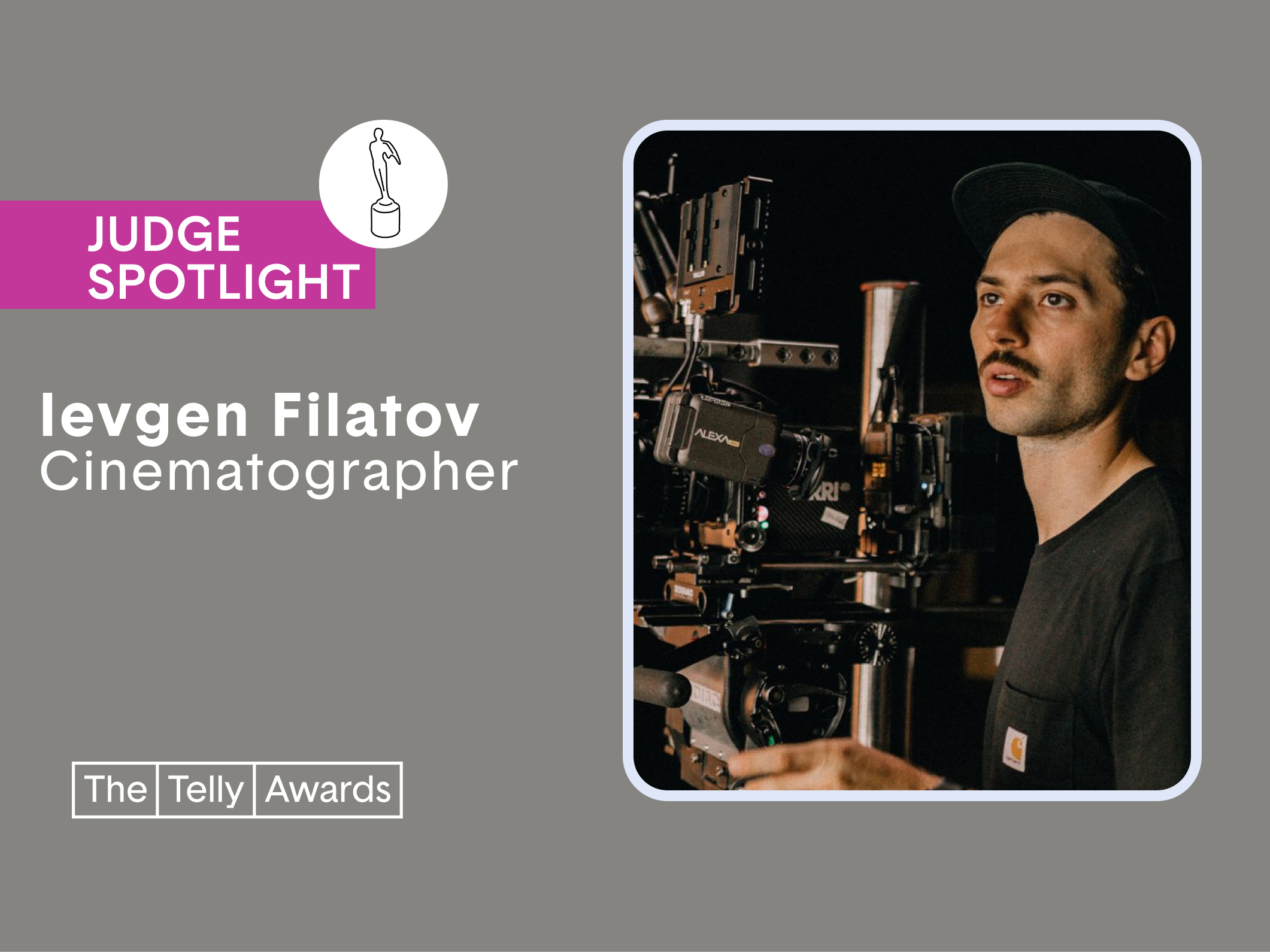
Ievgen Filatov is a cinematographer specializing in commercials, music videos, and short films. He graduated from a European film institute with a degree in cinematography. Eugene has been working in the film industry since 2014, consistently bringing a polished visual style to every project he takes on. His work combines technical precision with a strong sense of storytelling.
How many years have you been a judge?
This is my first year!
What excited you about judging for the Telly Awards?
I’m excited to judge for the Telly Awards because it’s a chance to celebrate outstanding visual storytelling and recognize the work of creators who push the craft forward. As a cinematographer, I’m always inspired by fresh ideas, innovative techniques, and bold artistic choices, and the Telly Awards bring together some of the best examples of that creativity. Being part of this process allows me to contribute to the filmmaking community while staying connected to the evolving standards of excellence in our industry.
What project are you most proud to have worked on?
I’m especially proud of a project called “Rusalka,” which I shot three years ago and has only recently been completed. The film is now being submitted to various festivals. We shot it on both 16mm and 35mm film, and it came with many exciting technical and visual challenges. One of the most ambitious scenes involved purchasing a vintage 1970s Mercedes, cutting off the roof, and filling the entire car with water to capture the moment when our main character sinks inside the vehicle. Operating a camera in a car completely filled with water was incredibly demanding, and coordinating scenes with large groups of people required extensive rehearsals to achieve the perfect result. Another major creative element was building a 60ft by 30ft pool on a soundstage and installing a 17ft by 11ft LED screen above it to create immersive reflections and lighting. I’m very proud of this project and truly hope audiences will connect with it.
What’s the most challenging part about your job and/or the industry?
One of the most challenging aspects of being a cinematographer is balancing creative ambition with the practical limitations of time, budget, and logistics. The industry moves fast, and every project demands quick problem-solving while still maintaining a high visual standard. It can also be challenging to constantly adapt to new technologies and evolving workflows. But these challenges are also what make the work exciting — they push me to stay innovative, flexible, and fully engaged in the craft.
What do you look for to determine excellence in video?
When determining excellence in video, I look for strong visual storytelling supported by intentional cinematography choices. I pay attention to how well the lighting, composition, color, and camera movement serve the narrative or concept. I also value originality—whether the piece brings a fresh perspective or elevates familiar ideas in a creative way. Finally, true excellence shows in the cohesion of all elements working together seamlessly, from performances to editing, sound, and overall emotional impact.
What are your current roles and responsibilities and what do you love most about your job?
As a cinematographer, my responsibilities include shaping the visual language of each project, collaborating closely with the director, and leading the camera and lighting teams to bring the creative vision to life. I oversee everything from pre-production planning and shot design to on-set execution and maintaining the visual consistency of the story. What I love most about my job is the ability to transform ideas into powerful images — creating emotions through light, composition, and movement, and working with talented people who share the same passion for storytelling.
What inspired you to pursue your career path?
I was inspired to pursue cinematography by my fascination with visual storytelling and the power of images to evoke emotion. Early on, I realized how strongly lighting, composition, and movement could shape the way a story is felt, and that sparked my desire to learn the craft on a deeper level. Studying at a film institute in Europe helped me understand cinema not just as a profession, but as an art form, and since 2014 I’ve been driven by the challenge of creating meaningful, memorable visuals. What keeps me inspired is the ability to collaborate with talented people and turn ideas into something tangible and cinematic.
In your experience, what is a significant change you are seeing happen in the video, television, and/or film industry, and what insight can you share about how to navigate it?
One significant change I’m seeing is the rapid integration of virtual production and LED technology into filmmaking. These tools give creators more control over environments, lighting, and timing, allowing for more efficient shoots without sacrificing visual quality. At the same time, there’s a growing appreciation for practical effects and authentic, in-camera storytelling, creating a balance between digital innovation and traditional craftsmanship.
Another major shift is the explosive growth of vertical content. We’re seeing an entire ecosystem of new platforms and series built specifically for mobile viewing, with short-form vertical storytelling evolving at a very fast pace. I believe that soon major streaming platforms will start producing their own vertical-format series designed for phones, making this format a standard part of the industry.