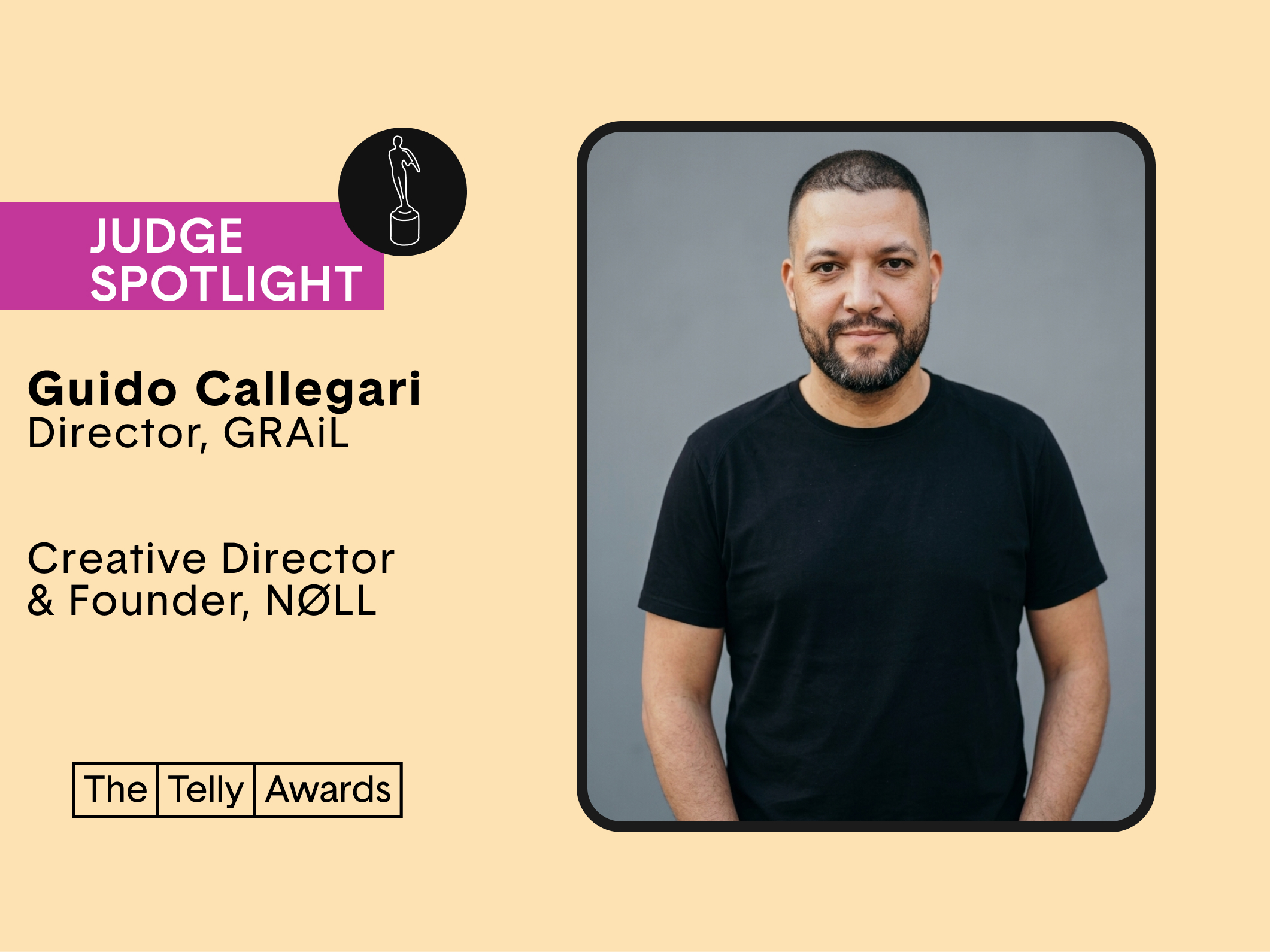
Guido Callegari is a Creative Director and founder of NØLL, and a Senior Art Director with over 15 years of experience in communication, advertising, and video production. His work focuses on AI-driven visual storytelling, exploring how artificial intelligence can expand creative language while preserving strong authorship and cinematic intent. He operates at the intersection of design, technology, and narrative, where experimentation meets production-ready execution.
He is a Director in the roster of GRAiL, a USA-based Next-Gen Entertainment Studio powered by AI and Management Company, where he contributes to narrative and experimental projects that explore new production models for advertising, entertainment, and original IP. Within GRAiL, he works on developing scalable AI workflows, visual worldbuilding, and storytelling formats that bridge creative ambition with technical reliability. This role represents a central pillar of his professional identity and an environment where research, production, and storytelling converge.
His work has been recognized with a Silver ADCI Award, one of Italy’s most prestigious honors in creative communication, acknowledging his ability to merge innovation with strong creative direction and meaningful ideas.
Alongside his work at GRAiL, he collaborates with global brands and agencies, helping them rethink creative processes, optimize production pipelines, and adopt AI-driven workflows that balance efficiency with expressive quality. His projects often focus on narrative-driven content, cinematic language, and hybrid physical-digital experiences.
Education plays a fundamental role in his practice. He teaches Generative AI in master programs and at leading Italian schools of communication, working with art directors, designers, filmmakers, and strategists. His teaching emphasizes a critical and conscious approach to AI, focusing on ethics, transparency, and creative responsibility, rather than tool-centric thinking.
He is also a frequent speaker at major AI, communication, and creative technology festivals and events, most recently at the Venice Film Festival, where he contributed to discussions on AI-driven storytelling and the future of visual culture.
At the core of his work is the belief that artificial intelligence should amplify human creativity, not replace it. He actively promotes ethical, transparent, and human-centered approaches to AI, aiming to protect authorship, inclusivity, and cultural value while pushing the boundaries of contemporary storytelling.
How many years have you been a judge?
This is my first year!
What excited you about judging for the Telly Awards?
What excited me most about judging for the Telly Awards was the prestige and legacy of the award itself, and the opportunity to contribute to such a respected international platform. Being part of a jury at this level carries a real sense of responsibility, knowing that each decision helps recognize and elevate work from across the global creative industry.
From my perspective, it was important to bring my own experience and background into the process, balancing craft, storytelling, and execution with a fair and open mindset. You’re not just judging what you personally like, but what truly stands out in terms of quality, intention, and impact.
It’s a role that requires both critical thinking and humility, and that’s what made it such a meaningful and rewarding experience for me.
What was your first job in the industry? What did it teach you?
My first job, while I was still a student, was as a graphic designer in a company producing promotional gadgets. It gave me the opportunity to see the entire production chain firsthand and to work closely with different suppliers, understanding each phase of the process in detail.
What I took from that experience, and what still guides me today, is that you can imagine the most creative ideas in the world, but you need to know exactly how to bring them to life. Having control and awareness of every stage of production is essential to turning vision into reality.
Equally important was learning to trust and collaborate with the people around you. Working with skilled professionals and relying on their expertise is not just valuable, it’s fundamental to achieving the best possible result.
What project are you most proud to have worked on?
One of the projects I’m most proud of is Memor.IA for Pulsee, a short documentary presented during Milan Pride that tells the stories of four individuals who experienced exclusion, missed opportunities, and moments where they felt unseen. The film reconstructs those “missing memories,” transforming them into powerful, universal reflections on identity, rights, and belonging.
What makes this project particularly meaningful is how technology was used with a higher purpose. Through artificial intelligence, we were able to give form to experiences the protagonists were never able to live, creating new memories that speak not only to their personal journeys, but to broader social issues.
On a personal level, what stayed with me the most was the deep connection with the protagonists and their stories. It wasn’t just about creating images, but about listening, understanding, and translating real emotions into something authentic and respectful. That balance between human sensitivity and creative execution is what made Memor.IA such a powerful and unforgettable experience for me.
What’s the most challenging part about your job and/or the industry?
One of the most challenging parts of my job is helping people truly understand the difference between work driven by real expertise and work that simply uses the same tools without a solid foundation. Today, the gap between these two approaches is significant, both creatively and in terms of production, but it’s not always immediately visible.
A big part of the challenge lies in shifting mindset. We often step into systems that have relied on the same production logic for years, and introducing new workflows requires not just tools, but a different way of thinking, planning, and executing. This transition can be complex and sometimes requires time, dialogue, and trust to be fully understood.
At the same time, the industry itself is going through a broader transformation, where new technologies are reshaping workflows and redefining roles, not replacing creativity but changing how it’s structured and delivered.
In the end, though, results speak for themselves. Once the process is understood and applied correctly, the difference becomes clear, both in the quality of the output and in the efficiency of the production.
What do you look for to determine excellence in video?
For me, excellence in video comes from a precise alignment between idea, execution, and impact. A strong piece starts with a clear and distinctive concept, something that feels intentional and necessary, not just well-crafted on the surface.
I pay close attention to storytelling and direction: how the narrative unfolds, how each shot contributes to the whole, and whether the visual language is coherent and purposeful. Craft matters, of course, cinematography, editing, sound, but only when it serves the idea rather than overshadowing it.
What really makes a piece stand out is when everything works in harmony and leaves a lasting impression. It doesn’t have to be complex or spectacular, but it needs to feel authentic, well-resolved, and capable of communicating something that stays with you beyond the final frame.
What are your current roles and responsibilities and what do you love most about your job?
As a Director, my role is to put tools at the service of storytelling, designing workflows that can fully translate emotion, intention, and narrative depth into the final piece. It’s about building a bridge between creative vision and production strategy, ensuring that every choice, from concept to execution, contributes to a cohesive and impactful story. Quality, for me, comes from a precise and thoughtful balance between creative direction and production efficiency.
What I love most about my job is the constant challenge. Every project brings a new set of constraints and opportunities, both creatively and technically. No two problems are ever the same, and that’s what keeps the process exciting. It pushes me to evolve, to rethink solutions, and to raise the bar every single time.
What initiatives or projects are you working on now that excite you?
The most exciting project I’m working on right now is still under NDA, so I can’t share too many details just yet… but you’ll see it very soon 🙂
Do you have any specific practices you lean on to spark creativity?
For me, creativity starts with observation. I try to absorb what’s happening around me at 360°, not just within my field, but across different worlds, cultures, and disciplines. At the same time, I constantly shift perspective and think as a viewer: what would someone feel, perceive, or remember from this project? That emotional point of view becomes a key compass in the process.
My main approach is to let emotion guide what I create. Before thinking about technique or execution, I focus on what the piece should make people feel. If that emotional core is clear, everything else tends to align more naturally around it.
I also embrace what many would consider “mistakes,” especially in generative processes. Unexpected outputs or imperfections are often where the most interesting ideas emerge. Instead of discarding them, I treat them as opportunities, signals that can lead to something original and less predictable.
In the end, it’s a balance between awareness, intention, and openness. Observing deeply, thinking from the audience’s perspective, and staying receptive to the unexpected are the practices that keep my creativity alive and evolving.
What inspired you to pursue your career path?
At a certain point in my career, I felt my creativity was being suffocated, not just by budgets and production limits, but also by the closed mindset of those above me. There was a sense of hitting invisible walls, where ideas were filtered, reduced, or stopped before they could fully take shape.
Then AI arrived and, almost immediately, showed me a completely different path. Those walls disappeared. The technical and economic barriers became much lighter, and for the first time I felt truly free to explore ideas without constant constraints. It allowed me to access worlds I once thought were out of reach and to express myself in a much more direct and authentic way.
From there, my thinking evolved. It became less about adapting to existing systems and more about building my own creative identity outside of rigid structures. AI didn’t just unlock new possibilities, it gave me the freedom to think, experiment, and create without limits.
I even have a tattoo that reminds me of that exact turning point: “/imagine”. For me, it’s much more than a command, it represents the moment everything opened up, and a constant reminder to keep pushing beyond perceived limits.
In your experience, what is a significant change you are seeing happen in the video, television, and/or film industry, and what insight can you share about how to navigate it?
One of the most significant changes I’m seeing across the video, television, and film industry is the widespread integration of AI at every level of production. It’s not just a new tool, it’s reshaping the entire creative approach, turning what was once impossible or inaccessible into something achievable.
Today, more than ever, stories have the opportunity to be told, expanded, and amplified without the same constraints that defined the industry for years. This shift is opening the door to new voices, new formats, and new ways of thinking about production and storytelling.
At the same time, navigating this transformation requires clarity. The key is not just adopting the technology, but understanding how to integrate it into a solid creative and production workflow. Tools alone are not enough, what makes the difference is the vision behind them, the ability to guide them, and to maintain a strong narrative core.
For me, the real insight is this: focus on storytelling first, and let technology serve that vision. The industry is evolving fast, but those who will stand out are the ones who can combine creative direction, technical understanding, and a clear point of view.