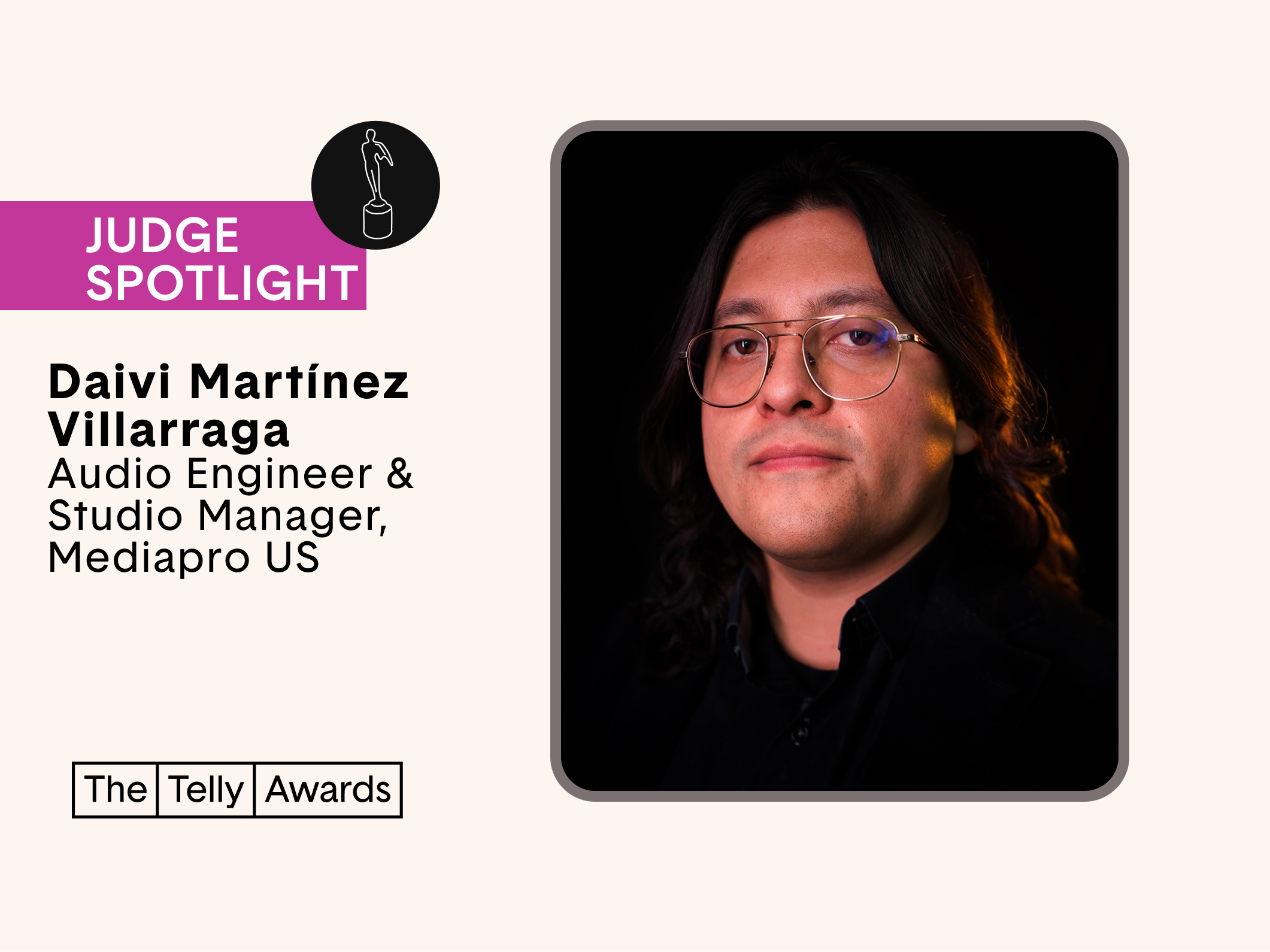
Daivi Martínez is a Colombian audio engineer and studio manager based in New York, working across film, broadcast, and live media production. His work spans location sound, post-production, and editorial collaboration on narrative-driven projects. He has contributed to internationally recognized productions including the short film Coral (Grand Prix, Warsaw International Film Festival) and A Photograph Dies (featured by Sony Alpha Universe), as well as live sports broadcasts and large-scale event productions in the United States. He collaborates with Mediapro US across live broadcast operations and technical production workflows, supporting major sports and event programming. In addition to his broadcast work, he oversees technical and operational coordination at Mediapro US’s Manhattan studio, supporting high-profile clients and production teams across rehearsals and live events.
How many years have you been a judge?
This is my first year!
What excited you about judging for the Telly Awards?
Apart from the professional recognition, what excited me most was the responsibility. I’ve built my career at the intersection of creative collaboration, technical execution, and narrative structure, and I felt that perspective could contribute to a selective process like this. Every judge brings a different operational mindset, and I saw it as an opportunity to add mine to that collective engine.
In an era of overstimulation and short attention spans, we need strong referents. We need work that reminds us why we create in the first place pieces that make someone pick up a camera, write a script, or pursue an idea with intention. Being part of identifying and elevating those examples felt both meaningful and necessary.
What was your first job in the industry? What did it teach you?
My first experience in the industry happened almost by accident. While I was studying music and audio engineering, close friends in film school needed someone to handle sound for their short films. I said yes before fully understanding what that meant. After a brief crash course with a professor who walked me through basic set etiquette, I stepped onto set and began learning in real time.
Very quickly, I realized something important: I wasn’t just recording sound. I was responsible for it from beginning to end. I handled pre-production planning, captured audio on set, and then sat in post trying to solve whatever problems I had created. If I made a mistake during production, there was no one else to fix it. That accountability was uncomfortable at first, but it was formative.
Being present in every stage changed how I understand filmmaking. I saw how decisions in pre-production affect production, and how production directly impacts post. It taught me that communication between departments is not optional it’s structural. When you experience the full arc of a project, you understand that no phase operates in isolation. That early responsibility shaped my approach: always thinking about continuity, coordination, and how each decision echoes across the entire process.
What project are you most proud to have worked on?
One project that represents me deeply is A Photograph Dies, a documentary exploring the creative process of photographer Jean-Paul Bourdier, known for his large scale body painted landscape compositions. I co edited the film with Esteban Toro, and during postproduction I approached its structure the way I approach a musical composition, organizing the creative journey into narrative acts that mirrored the evolution behind a single photograph: idea, attempt, frustration, near revelation, renewed doubt, chaos and finally clarity.
During production, many of Jean Paul’s reflections were recorded spontaneously as brief philosophical thoughts, captured without a predetermined structural intention but simply as material that might later find a place in the edit. In postproduction, I grouped those fragments thematically and integrated them into a cohesive progression, allowing each stage to develop its own emotional and sonic identity with the music and the sound design. Gradually, the film built toward one of those recorded reflections, which ultimately gave the documentary its title: “A photograph dies if it moves only the senses, and lives if it opens the doors to the unknown.”
For me, that project reflects how rhythm, sound, and structure shape meaning, not as background elements, but as narrative architecture.
What’s the most challenging part about your job and/or the industry?
One of the most significant challenges I see is the growing pressure to prioritize speed and volume over depth and refinement. There’s an increasing demand to produce more content, faster, and sometimes the metric of success becomes output rather than intention or craft.
Of course, there are still areas of the industry (particularly at higher levels of production) where standards remain extremely rigorous. But the overall acceleration can create tension. I don’t think pressure is inherently negative; in many cases it sharpens efficiency and decision-making. The challenge is making sure that urgency never replaces thoughtfulness, and that speed does not quietly lower creative standards.
For me, maintaining that balance is essential. Production realities evolve, but instinct and craft should remain non-negotiable.
What do you look for to determine excellence in video?
I look for control of tension and release. At its core, every art form operates through that dynamic, whether consciously or not. Film, like music, painting, or literature, is shaped by how it builds, sustains, and resolves emotional or narrative tension. When a piece understands that internal engine, it feels intentional and cohesive.
Technical polish alone doesn’t define excellence. I’m interested in whether the form supports the idea whether pacing, sound, silence, image, and structure work together toward a destination. Some of the most powerful works are not loud or spectacular; they are disciplined and deliberate, allowing tension to breathe before releasing it.
What often weakens a piece is confusing stimulation with meaning. Production value can enhance a story, but it cannot replace narrative architecture. Excellence, for me, comes from intention, restraint, and emotional rhythm.
What are your current roles and responsibilities and what do you love most about your job?
My work moves between narrative film, live broadcast, and studio production, operating across both the technical and creative dimensions of sound. That can mean structuring workflows, collaborating with directors, refining a sequence in postproduction, or supporting a live environment where decisions have immediate consequences.
What I value most is the moment when ideas take form. Whether it happens in a preproduction conversation, inside a DAW shaping an emotional arc, or during the pressure of a live broadcast, there’s a point where abstract intention becomes something real and shared. I’ve experienced how a film, a piece of music, or a broadcast can subtly shift someone’s internal state. Being part of building those moments from concept to execution is what makes the work purposeful to me.
What initiatives or projects are you working on now that excite you?
Right now I’m moving between two very different but connected worlds. On one side, I’m involved in studio and live broadcast environments where preparation and decision-making happen in real time. On the other, I continue working on narrative projects where the process is slower and more reflective.
What excites me is the contrast. Live production demands precision and calm under pressure, while narrative work allows space to shape ideas more deliberately. Moving between those spaces keeps me attentive, it prevents the work from becoming mechanical.
I’m most energized when both disciplines inform each other, when the clarity required in live production sharpens storytelling, and when narrative thinking brings intention into technical environments.
Do you have any specific practices you lean on to spark creativity?
Across disciplines, I’ve noticed a pattern: the most interesting ideas often appear when the inner critic is temporarily suspended. There’s a phase of creation that requires openness, almost a kind of automatic mode where you allow ideas to surface without immediately judging them. Most of what comes out in that stage isn’t extraordinary, but the spark of something meaningful usually emerges from that unfiltered process.
In music, you see this when artists improvise melodies using nonsense syllables before lyrics take shape. The evaluation comes later. I approach film scoring in a similar way. In a DAW, I’ll loop a section and record multiple spontaneous responses to the footage, reacting in real time without stopping to analyze. Only after accumulating material do I step back, listen critically, edit, consolidate and refine.
For me, separating creation from critique is essential. The instinct generates; the discipline shapes.
What inspired you to pursue your career path?
The moment that ultimately set the direction my career would continue to evolve from happened while watching an episode of Classic Albums that dissected Queen’s A Night at the Opera. At that young age, music and art in a broader sense felt almost mythic to me, as if they appeared fully formed, detached from the hands that built them. That episode pulled everything apart. The isolated tracks, the musicians describing arguments and revisions, the producer explaining experiments that failed before they worked. Suddenly, what felt monumental was revealed as something constructed through patience, friction, and collaboration.
What surprised me was that seeing the mechanics did not weaken the magic. It intensified it. The record became more impressive once I understood how many decisions, doubts, and adjustments were embedded in it. It was no longer just a finished object. It was a living process that had left traces behind.
That realization stayed with me. I became less interested in standing at the front of the stage and more interested in the space where things are shaped. Over time, that curiosity expanded beyond music into film, live sound, and broadcast. Whether in a studio, on set, or inside a control room, I still recognize the same pattern I saw in that documentary: meaningful work emerges from coordination, experimentation, and shared intention. Being part of that invisible construction is what ultimately defined the path I chose.
In your experience, what is a significant change you are seeing happen in the video, television, and/or film industry, and what insight can you share about how to navigate it?
One significant shift I notice is in how art is consumed. The environment today makes it very easy to encounter a constant stream of content without actively choosing it. Exposure often happens through repetition and visibility rather than through deliberate exploration.
There’s something powerful that happens when someone takes ownership of their artistic curiosity when they actively search for what moves them, rather than simply absorbing what is most present. That process of personal curation shapes taste, perspective, and depth of engagement.
Navigating the current landscape, in my view, means remaining intentional as a viewer as much as a creator. Staying curious, seeking work that genuinely resonates, and resisting purely passive consumption helps preserve a meaningful relationship with art.