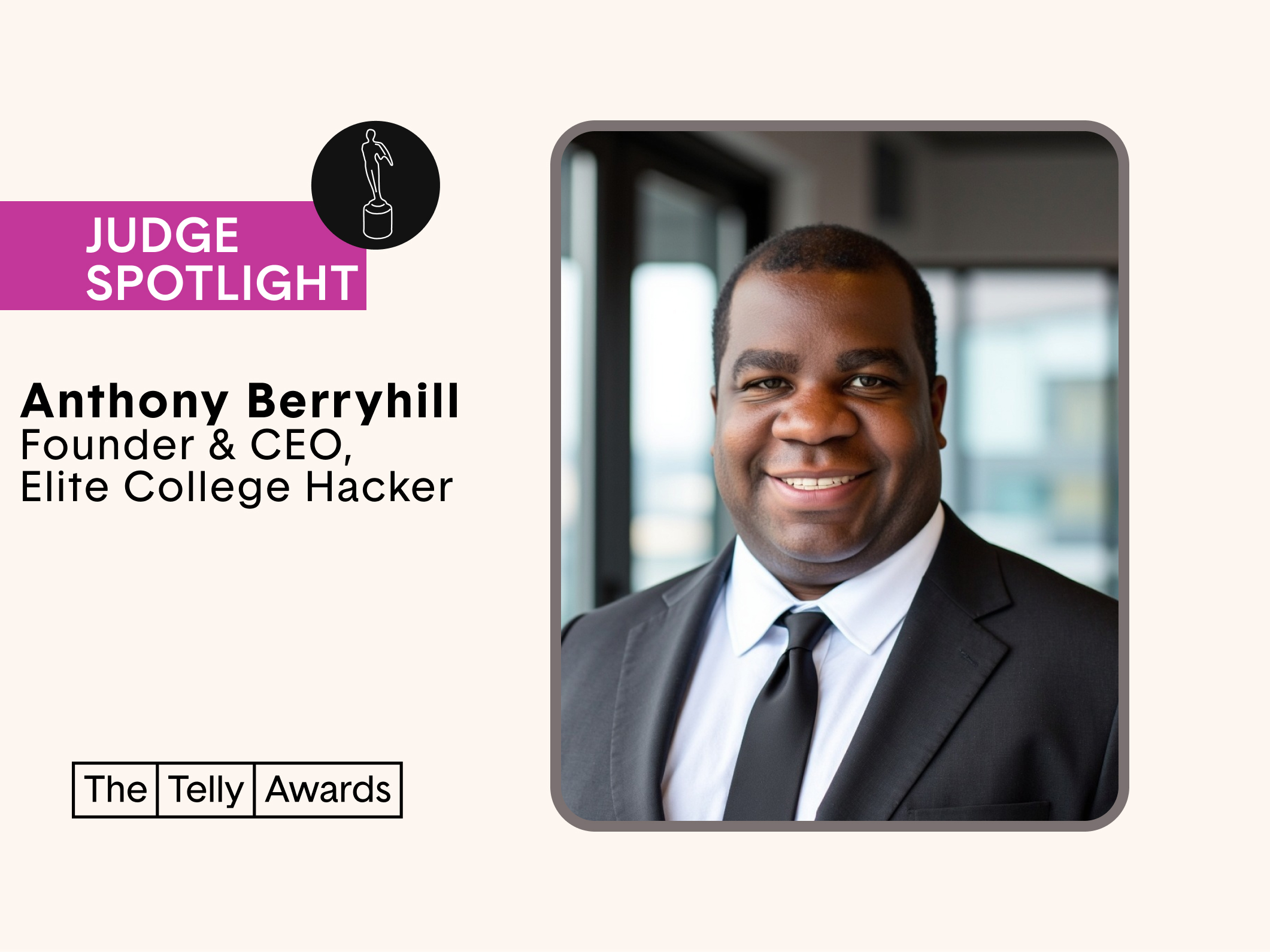
Anthony Berryhill, FRSA, is a global strategist and educational consultant specializing in the intersection of elite communication, social mobility, and corporate talent development. A former Vice President at PIMCO and a three-time National Champion Debate Coach, he brings a rigorous, systems-based approach to evaluating narrative impact and production quality. Named “Global Equity Champion for Education and Social Mobility” at the 16th World Leaders Summit at Oxford, Anthony currently serves on the instructional staff at Harvard University and is a Fellow of the Royal Society of Arts and the Royal Geographic Society.
How many years have you been a judge?
This is my first year!
What excited you about judging for the Telly Awards?
I am excited to see innovation across the wide range of screens and to get to see creative ideas, formats, and concepts first hand.
What was your first job in the industry? What did it teach you?
My first job after my PhD studies at Yale was working for an expert network firm, especially with clients from NY middle market firms. I learned how to communicate to different audiences (just like video!) and tenets of excellent client service.
What’s the most challenging part about your job and/or the industry?
The most challenging partis holding people emotionally, especially when parents behave in toxic ways. My job is sometimes to protect a student from toxic influences from family and friends (who confidently have zero understanding of education and admissions), or lies on social media. This is a general frustration which is that for such important work there are so many scammers and folks trying to take advantage—a problem not unique to education!
What do you look for to determine excellence in video?
First, I look for legibility – meaning, as a general audience member is it clear what I am watching and does it give me a reason to keep watching. Second, I look for some degree of innovation or creativity — that can be in the use of camera work, audio, and/or the content itself. Finally, I consider all of these factors in the context of the category and the purpose of the video.
What are your current roles and responsibilities and what do you love most about your job?
I have three roles and responsibilities. First, I serve as Instructional Staff at Harvard helping teach classes on public policy and negotiation. Second, I run my own ethics-first college admissions company that helps both U.S. and international students get into top Ivy/Ivy+ universities. Third, I have a life as a debate coach on the competitive national circuit, and I’m asked to help coach teams trying to win state and national championships, of which I’ve had 3 champions myself!
What initiatives or projects are you working on now that excite you?
The major project I am working on is building up my public persona and creating content that appeals to a larger global audience for my college admissions work. Based on student requests, I’m starting a content campaign to give the honest truth about how admissions works. Too many on TikTok and YouTube and Reddit say lies to people to scare them into giving lots of money and still get rejected since the advice that goes viral is not just bad, but catastrophically so.
Do you have any specific practices you lean on to spark creativity?
I read and watch things constantly that are outside of my wheel house. This helps with my teaching, but also my general exposure. On a random Friday/Saturday night, you will see me behave as what my students call me a “hyper nerd.” One day I maybe watching a video game review, another, a kpop game show, and a different day, a shonen anime.
What inspired you to pursue your career path?
My students – I started as a debate coach but eventually those students asked–no, demanded– I apply the advanced communications techniques to getting them into college. It was certainly not what I expected to do!
In your experience, what is a significant change you are seeing happen in the video, television, and/or film industry, and what insight can you share about how to navigate it?
I’m seeing an increasing globalization in the video, TV, and film industry, and that American audiences’ tastes are expanding (i.e., consider KPop Demon Hunters and the fact that Korean reality shows dominate streaming in the U.S.). I love seeing this and I suggest that the way to navigate this is to have a more cosmopolitan video of personas, viable content, and cultures.