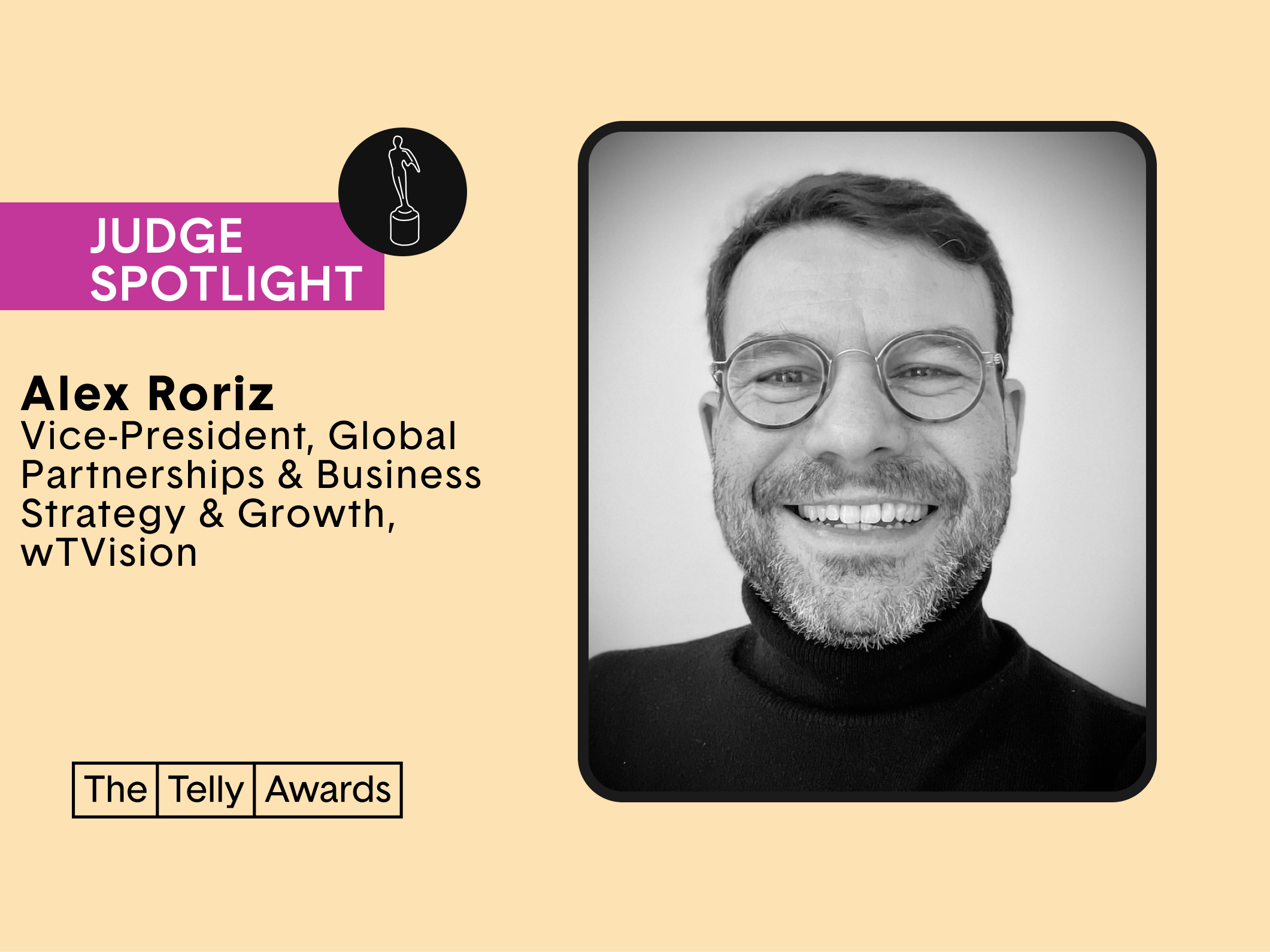
Alex Roriz is an international executive working at the intersection of technology, business strategy, and storytelling in the global media industry. With more than 25 years of experience, he has led companies, built partnerships, and driven product and go-to-market strategies across Europe, the Middle East, Africa, and the Americas.
Currently Vice-President of Global Partnerships, Business Strategy & Growth at wTVision, he focuses on aligning innovation with real creative and operational needs in live production environments.
Passionate about people, collaboration, and clear communication, Alex brings a global and human-centred perspective to media innovation and works fluently across English, Spanish, and Portuguese. He believes the most powerful stories emerge when technology empowers creativity and teams work together with clarity, trust, and shared vision.
How many years have you been a judge?
This is my first year!
What excited you about judging for the Telly Awards?
What excites me most is the opportunity to learn from the work of others and to contribute to recognising creativity that truly connects with people. The Telly Awards bring together different cultures, formats and perspectives, and that diversity is essential for the evolution of our industry. I value being part of a community that celebrates collaboration, craft and meaningful storytelling.
What was your first job in the industry? What did it teach you?
My first professional experience was in the marketing division of a bank headquarters, working on the development of new software applications. While studying, I was also teaching in a course organised by my university. These early experiences taught me that technology only has real value when it solves meaningful problems for people — and that communication is as important as technical knowledge.
What project are you most proud to have worked on?
One of the projects I am most proud of was the implementation of a fully integrated end-to-end graphics workflow for the new SIC broadcast facilities, launched in early 2019. It was one of the first environments of its kind built entirely on SMPTE 2110 standards still during 2018. I am also proud of many virtual and hybrid studio, augmented reality and robotics projects delivered across different countries — all shaped by strong collaboration with customers and partners.
What’s the most challenging part about your job and/or the industry?
The greatest challenge is not technology — it is people. Innovation requires bringing different perspectives together, managing expectations and building trust across teams. When the right environment for collaboration exists, even the most complex technical problems become solvable. Leadership today is about influence, empathy and alignment rather than hierarchy — and about distinguishing between technical challenges and adaptive human ones.
What do you look for to determine excellence in video?
For me, excellence starts with clarity of intention. The best work aligns story, emotion and visual language in a way that feels authentic and purposeful. Technical quality matters, of course, but what truly stands out is when technology becomes invisible and allows creativity and human connection to take the lead.
What are your current roles and responsibilities and what do you love most about your job?
I work across strategy, partnerships and product innovation in global media technology. My role is to bring teams together — engineering, creative, marketing and sales — to build solutions that help broadcasters and content creators tell better stories. What I love most is seeing ideas become real experiences on air, knowing they are the result of collective effort and shared vision.
What initiatives or projects are you working on now that excite you?
I have also launched a new mapping solution for editorial storytelling in news environments.
I’ve been also currently focused on developing mobile-first immersive experiences connected to broadcast content, designed to retain traditional TV audiences while attracting new generations and creating new revenue opportunities. In parallel, we are preparing a major upcoming innovation in real-time media workflows that will be announced at NAB.
Do you have any specific practices you lean on to spark creativity?
Creativity, for me, comes from constant curiosity and attention to detail. I work closely with design, engineering and marketing teams, exploring how real-time graphics and media workflows can evolve. Transforming complex ideas into simple, meaningful solutions is itself a powerful source of creative energy.
What inspired you to pursue your career path?
My path into broadcast was partly unexpected. After completing my degree in Mathematics and Computer Science and working in banking technology, I moved into product management for telemedicine systems. I was then invited to help lead the broadcast division of the company I was with. Early exposure to pioneering technologies and visionary teams made me realize that media technology sits at a unique intersection of innovation and human expression.
In your experience, what is a significant change you are seeing happen in the video, television, and/or film industry, and what insight can you share about how to navigate it?
Broadcasters and media organizations are increasingly recognizing that their most valuable asset is content — and that content must live across multiple platforms and experiences. The challenge is not only technological but also strategic and cultural. Success will depend on collaboration across disciplines, the capacity to publish everywhere, openness to new distribution models and keeping storytelling at the centre of innovation.