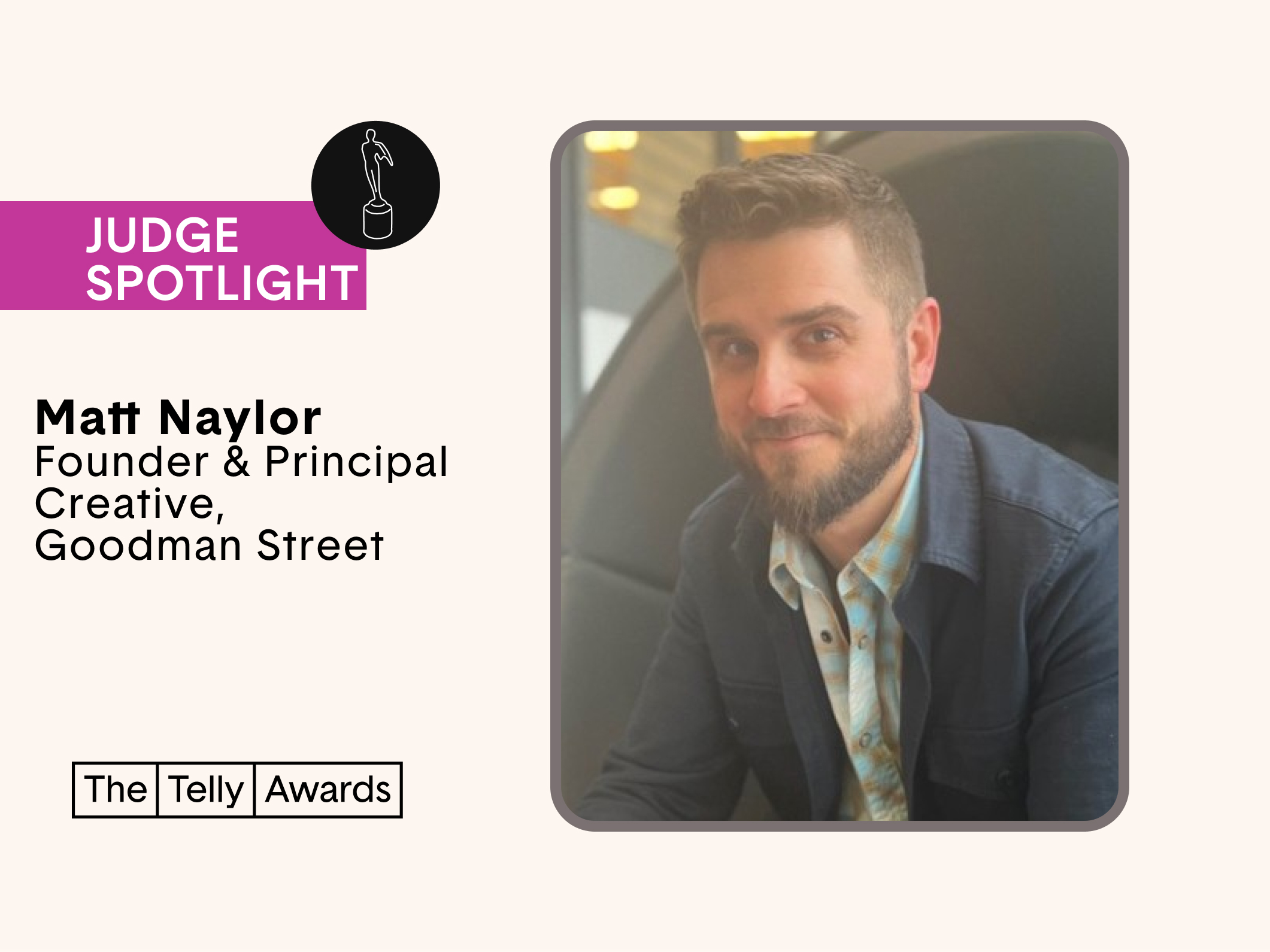
As the Founder and Principal Creative of Goodman Street, Matt Naylor has spent the last twenty years creating films, series, shorts, strategy, podcasts, and social media for marquee brands, nonprofits, and distributors. His work – consistently crafted with the ethos of Amplifying Good – has appeared on Netflix, Hulu, Prime, and others – garnering major festival awards, multiple Emmy-nominations, and even a #1 movie on Netflix. He’s also the co-host of a charting podcast on fatherhood, called “Milkless.”
How many years have you been a judge?
This is my first year!
What excited you about judging for the Telly Awards?
It’s a great excuse to interact with other people and work in the space. This is a pretty wild moment, and it sometimes feels like everybody is just trying to figure out what the heck is going on (let alone what’s coming next). The more we can do that together, the better.
What was your first job in the industry? What did it teach you?
I was a machine room operator at an editing/dubbing house. The job was incredibly detail oriented and mistakes weren’t really an option. I learned that, when you’re making art – whether it’s the creative components or the highly technical ones – you either strive for absolute excellence, or you fall on your face.
What project are you most proud to have worked on?
Tough one. We did a Netflix series called Wounded about Iraq/Afghanistan veterans that I was very proud to have co-directed. It felt a little ahead of its time in terms of talking about things like trauma, addiction, and repair through relationship.
What’s the most challenging part about your job and/or the industry?
It changes hilariously fast, so you never really get your feet completely under you. And then there are a lot of people holding the keys (and the money) who aren’t exactly in it for the art.
What do you look for to determine excellence in video?
Story and character. Exceptional production value and beautiful cinematography are – of course – a joy to behold. But they aways place a distant second behind how much I care about the people/narratives put in front of me. And flashy content designed to grab attention just for attention sake… I think that “genre” is on its way out.
What are your current roles and responsibilities and what do you love most about your job?
I’m currently Head of Creative for Goodman Street, and Creator/Co-Host of Milkless. Truthfully, a lot of production (and post in particular) is a slog. But I’ve stayed in love with it because I love 1) writing (and editing unscripted, which is basically writing) 2) collaborating with bright people, and 3) designing creative processes that get the most out of everyone involved… and feel good to be a part of.
What initiatives or projects are you working on now that excite you?
I’ve written three children’s chapter books – an ongoing series called Violet Archer about a kid detective (Violet) who solves cases with her dog. We’re currently rolling out a video component to those stories as well. Violet Archer is written to be fun – but it’s also about growing up, dealing with our complex internal lives, understanding how flawed and complicated adults are, and what’s its like to be a kid who doesn’t always feel understood. I think they’re the best things I’ve ever written.
With Milkless, we’ve been able to build a pretty devoted listener base and a decent social following – so we’re using that platform to get the books out to the world – in partnership with prominent Mom influencer (#bigtimeadulting), who voices Violet in the audio/video book.
Do you have any specific practices you lean on to spark creativity?
I take a lot of walks. I also work whenever the inspiration strikes. Sometimes that means I go until 3am and lose the next morning – but 3 hours in “the zone” is worth a week of banging your head against the creative wll.
What inspired you to pursue your career path?
I was pretty scared as a little kid – had a few fairly traumatic experiences early on that were formative. A mentor of mine suggested that maybe I should start writing. “When you’re a writer,” he told me, “nothing is wasted.” I’ve been writing ever since, and it’s probably no mistake that my most successful projects have always had a scary element to them.
In your experience, what is a significant change you are seeing happen in the video, television, and/or film industry, and what insight can you share about how to navigate it?
If you’re not paying for something, you’re not the customer. You’re the product. People mostly don’t want to pay for video anymore… which means that most video has to sell something else to its audience. There are ways around that dynamic – whether it building a devoted following and distributing directly to them, or finding a natural revenue engine that’s connected to your video.
At this point in my career, with kids and mortgage on all that, I don’t get too far down the road on any project without figuring out how it’s going to be sustainable. I got into this business to be an artist, not an entrepreneur – but, if you want to make projects you believe in, you sort of have to be both.