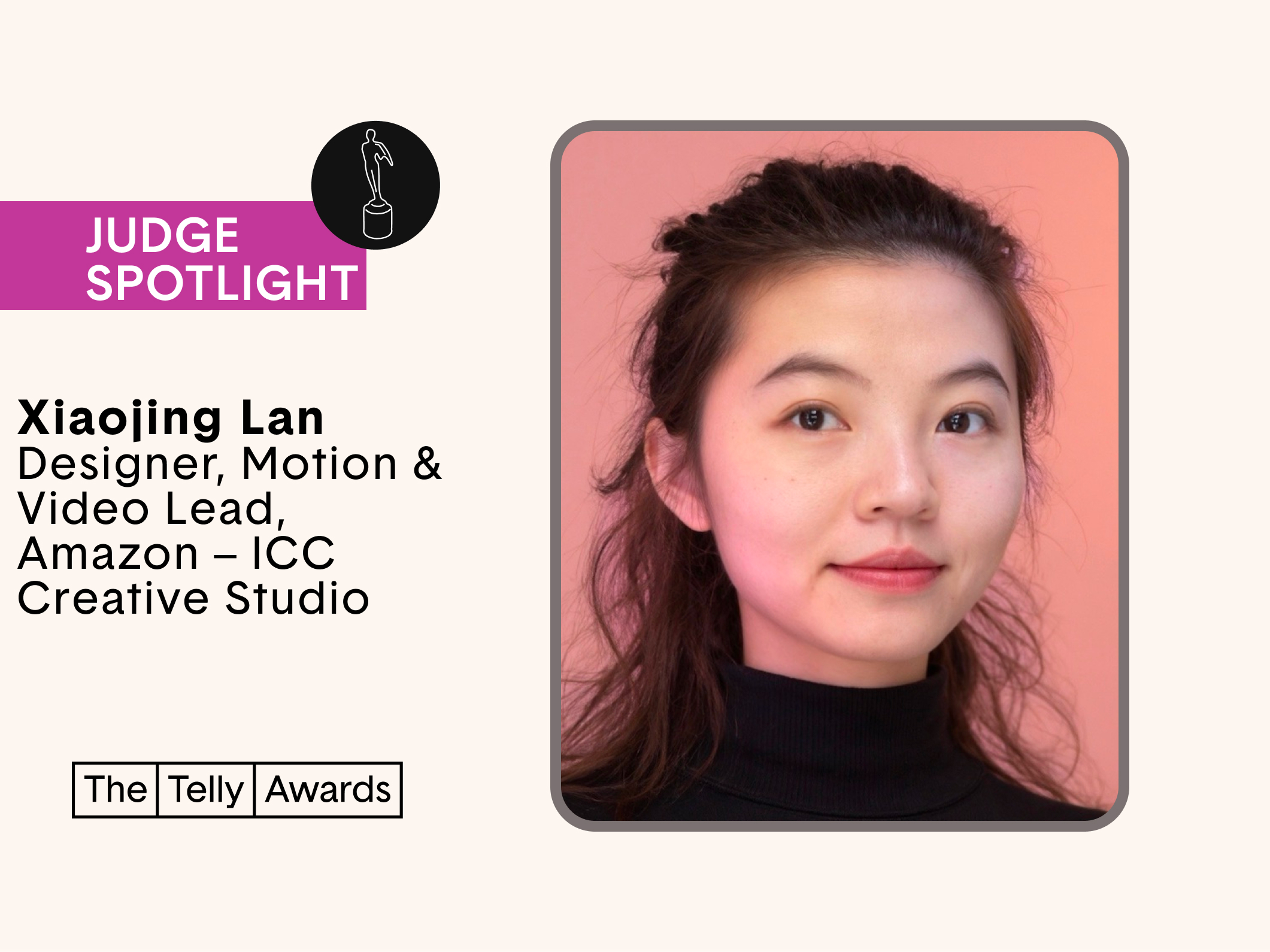
Effy Lan is a motion designer and video lead at Amazon’s Internal Corporate Communications Creative Studio, where she creates large-scale motion systems, brand films, and cross-channel video campaigns for company-wide initiatives. With a background in visual communication and a master’s degree in Digital Media from the University of Washington, she specializes in blending design, animation, and editorial storytelling to simplify complex narratives. Prior to Amazon, she led global video projects for tech companies such as Shopee and BingX, delivering multilingual content and managing cross-functional production pipelines. Effy’s work focuses on crafting emotionally resonant visuals that elevate internal narratives into meaningful experiences for global audiences.
How many years have you been a judge?
This is my first year!
What excited you about judging for the Telly Awards?
I’m excited about the opportunity to experience the breadth of creativity happening across the global video community. As someone who works at the intersection of design, motion, and storytelling, I love seeing how different teams push visual language, pacing, and narrative clarity in new directions. Judging for the Telly Awards allows me to learn from other creators, celebrate innovative craftsmanship, and contribute to a platform that recognizes excellence in our industry. It’s meaningful to be part of something that elevates the voices behind impactful visual storytelling.
What was your first job in the industry? What did it teach you?
My first job in the industry was creating educational animations for a K-12 learning company, where I focused primarily on content for programming education. It was a very formative experience—translating abstract technical concepts into visuals that young students could intuitively understand taught me the importance of clarity, pacing, and user-centered communication. That early foundation shaped the way I approach storytelling today: making complex ideas approachable without oversimplifying them. After working in education, I moved into the e-commerce space at Shopee, where I applied those same principles to larger-scale production and cross-functional collaboration.
What project are you most proud to have worked on?
One of the projects I’m most proud of is the series of award-winner videos I created for Amazon’s All-Amazon Global Meeting (AAGM). Each year, hundreds of thousands of employees watch these films, so our goal was to elevate the experience beyond a standard corporate highlight. I led the motion and video direction—from on-site interviews with award recipients and their teams, to understanding the real impact of their work, to reshaping each narrative into a cohesive visual story.
What made this project meaningful was the human connection behind it. Spending time with teams across different functions gave me a deeper appreciation for the innovation and resilience inside the company. Translating their stories into a visual language that felt authentic, emotionally grounded, and cinematic was both challenging and rewarding. Seeing the final pieces resonate across the entire organization reminded me why I love this craft: storytelling has the power to make internal moments feel truly memorable.
What’s the most challenging part about your job and/or the industry?
The most challenging part is balancing creative ambition with the realities of large-scale production systems. In a fast-paced environment like Amazon, projects move quickly, priorities shift, and alignment often involves many teams across different disciplines. Staying visually inventive while navigating constraints requires a lot of clarity, communication, and adaptability. Industry-wide, the challenge is similar—audiences expect higher sophistication in design and storytelling, yet timelines and resources don’t always grow proportionally. That tension pushes me to be intentional: making sure every decision in the motion or editorial process serves the core message.
What do you look for to determine excellence in video?
I look for clarity of intention—whether the creative choices genuinely support the story the piece is trying to tell. Strong craft matters, but I’m especially drawn to work where design, motion, and editorial come together cohesively rather than feeling ornamental. I pay attention to pacing, transitions, typography, and how visual rhythm enhances emotion. Most importantly, excellence shows up when a video leaves a memorable impression not because it tried to be loud, but because every element worked purposefully to communicate something meaningful.
What are your current roles and responsibilities and what do you love most about your job?
I currently lead motion and video projects at Amazon’s ICC Creative Studio, where I design animation systems, produce internal brand films, and manage cross-functional workflows with editorial, design, and strategy teams.
My role spans creative direction, motion design, video editing, and building scalable processes that help our team deliver high-impact content across the company. What I love most is the ability to shape narratives that reach hundreds of thousands of employees—turning complex topics into visually engaging stories that foster connection within a large organization. I also enjoy mentoring teammates and elevating the design rigor of our internal motion practice.
What initiatives or projects are you working on now that excite you?
I’m currently leading several internal brand film and motion initiatives at Amazon, including new visual systems for company-wide communications and high-visibility narrative videos for global employee programs. What excites me most is the opportunity to rethink how internal stories are told—moving beyond traditional corporate formats and exploring more cinematic pacing, animation-driven transitions, and emotionally grounded editorial direction. These projects also give me space to experiment with building scalable motion libraries and workflows that will benefit our entire creative team long-term.
Do you have any specific practices you lean on to spark creativity?
I often find creativity in places outside traditional design references. Long walks, reading philosophy, and observing pacing in films or even everyday interactions help reset my perspective. I also build small motion experiments that aren’t tied to deliverables—just to explore rhythm, type behavior, or color relationships. Another practice is simplifying: when I feel stuck, I revisit the core message and strip away anything that doesn’t serve it. Creativity comes more naturally when the intention is clear.
What inspired you to pursue your career path?
My career path began in a very experimental place—during my senior thesis, I created an interactive AR installation that blended space, motion, and digital storytelling. It was the first time I saw how technology, design, and narrative could coexist to shape an emotional experience for an audience. That project made me realize that I was most energized when I was building something that moved—visually, conceptually, or emotionally.
As I continued my career, that early curiosity naturally evolved into motion design and video storytelling. Whether I was creating educational animation for K-12 programming courses, producing high-volume content in e-commerce, or now leading narrative-driven internal films at Amazon, the core motivation has stayed the same: using visual storytelling to make complex ideas feel human and accessible. That initial spark from my AR installation still influences the way I approach every project today.
In your experience, what is a significant change you are seeing happen in the video, television, and/or film industry, and what insight can you share about how to navigate it?
One of the most significant changes I’m seeing is the acceleration of AI-assisted tools in every stage of the video pipeline—from ideation and scripting to editing, localization, and motion design. Instead of replacing creativity, these tools are reshaping what creativity looks like. The industry is shifting from valuing pure technical execution to valuing clarity of storytelling, taste, and direction. When software can generate options instantly, the differentiator becomes the ability to choose, refine, and guide those options into something intentional and human.
Another big shift is the growing expectation for authenticity. Audiences are responding less to overly polished, formulaic visuals and more to narratives that feel grounded, personal, and emotionally sincere. Even in internal corporate work, we see a strong desire for films that feel real—stories of actual people, honest challenges, and meaningful impact.
To navigate this change, I think it’s important to stay adaptable: embrace new tools without letting them dictate the creative process, stay curious about emerging formats, and continuously sharpen your point of view as a storyteller. Technology will keep evolving, but a strong sense of intention—and the ability to craft something that resonates—will always remain core to the craft.