Tell us a bit about your organization and what your specialty is in the film and video space.
MetroEast uses media to invigorate civic engagement, inspire diverse voices, and strengthen community life. MetroEast Community Media is a 501(c)(3) nonprofit community media center based in Gresham, Oregon.
We teach media and we produce professional videos for nonprofits, schools, and government organizations.
We have an Emmy-nominated Production Team that offers fee-for-service videos to promote your nonprofit and tell their story. We also produce educational videos, how-to videos and documentaries. Our earnings are used to further the mission of invigorating civic engagement, inspiring diverse voices and strengthening community life.
What is your organization’s ethos and how does it set you apart from industry competitors?
We are a nonprofit Community Media Center that teaches the public how to create their own media in addition to producing professional video content. We teach workshops on video, photography, VR and other creative media. Everything we do incorporates diversity, equity and inclusion (DEI).
Over 1,000 members of the community are engaged in our programming every year through a range of offerings, from free digital literacy access for our community’s most underrepresented populations, to professional-quality equipment and training for independent filmmakers and content creators.
Media created at MetroEast reaches into over 350,000 homes in the greater Portland area via six cable channels. The content produced in our studios has been invited to the White House and has received multiple Emmy nominations.
How can people join or learn more about what you do?
Tell us about your Telly Award winning piece. What’s the story behind it?
Food Foray is a MetroEast original docu-series that journeys through the aisles of international groceries and into home kitchens, uncovering immigrant stories woven into the flavors of East Portland and Gresham. We set out to create a documentary series that celebrates Oregon’s most diverse zip code through the most universal connector of all—food. Our production team is heavily comprised of immigrants from Bosnia & Herzegovina, Mexico and Scotland so we each brought our own personal experience into the making of this series.
What are you most proud of about this piece? What was your biggest challenge during production and how did you solve it?
We are the most proud of how we were able to capture such raw and intimate conversations over the dinner scenes. It’s a testament of the bravery and openness of our “subjects” who are now friends. These emotional conversations are what sets Food Foray apart from other food/travel shows like Anthony Bourdain’s Parts Unknown. We also also very proud of our first year of self distribution and how many screenings we’ve had in theaters around town that have featured food made by our Food Foray guests so audiences were able to taste the dishes as they watched the episodes. The biggest challenge at the beginning was finding participants who wanted to open up their lives (and kitchens!) to us, but now that we have a proof of concept it is getting easier!
Do you have any advice to other filmmakers based on your career or your team’s approach to work?
Team up with your local community media center to get help producing your own work!
Can you share a behind the scenes story or fun fact about the making of your piece?
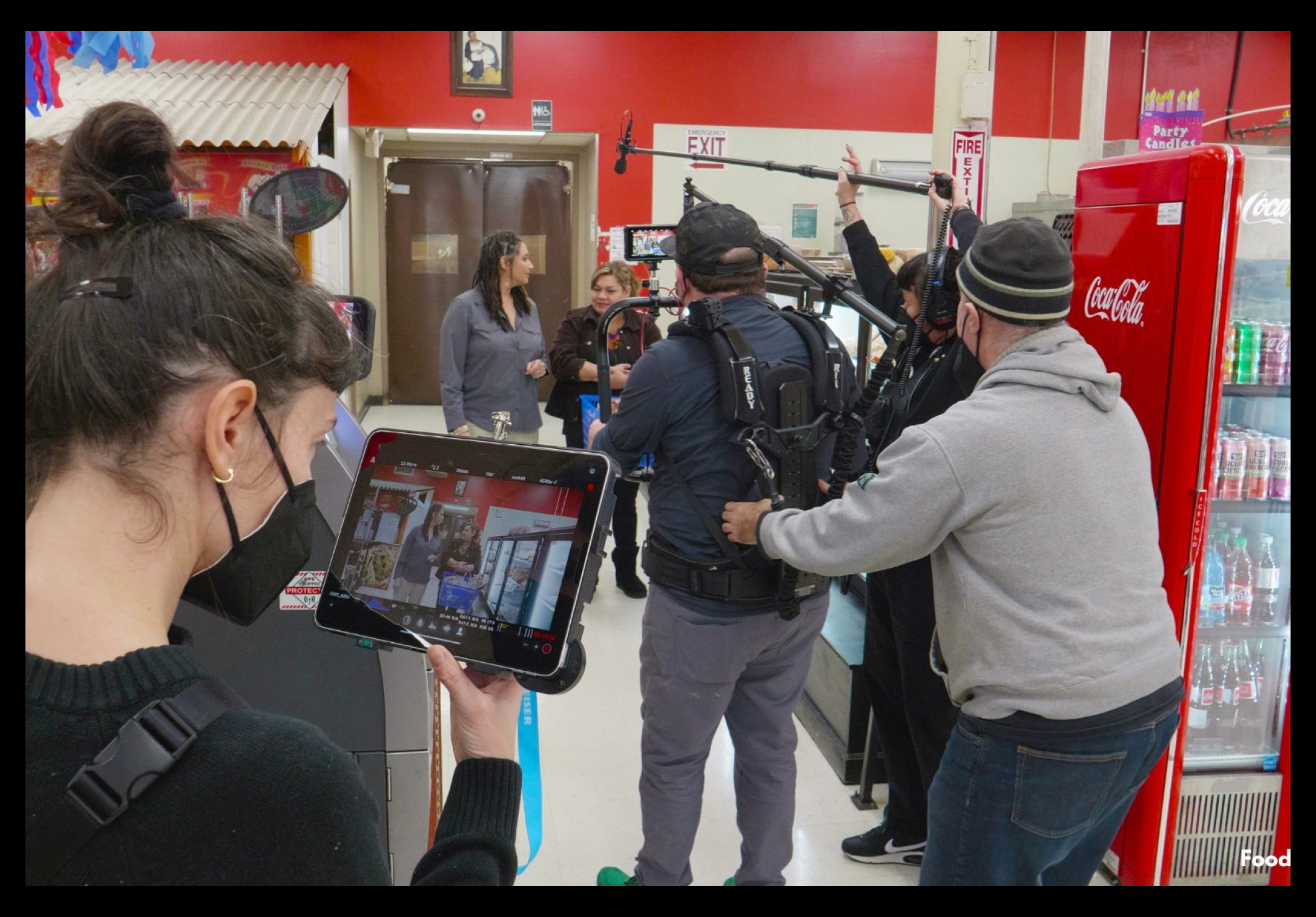
Our director, Ivana, was pregnant during the production of the pilot episode and the Russian store we were filming in had such narrow aisles that the crew routinely bumped into her baby bump in between takes!
Tell us about the most memorable response you got from this work.
This write up by Denise Chin comes to mind:
Food is a critical memory bank, a salve for the ache of homesickness, an avenue to preserve culture that could easily be forgotten; it is a point that Food Foray evocatively told across three spectrums. Every episode displayed the characters’ passion and pride to share food from their heritage. Here, two worlds collide—food memories from lives past, and life now in Oregon, having access to specialized ingredients. Therein lies the beauty of the messaging in Food Foray. The series highlights universal sentiments and burdens we carry as immigrants in the US, like the people we left for new opportunities. Whether it was coming to terms with being separated from a sibling for an undetermined amount of time or never seeing one’s birthplace again in exchange for safety and stability, these stories showed the strength and resilience it takes to build a new life away from home.
Complete this sentence: ‘Great video storytelling is…’
… felt in your body.