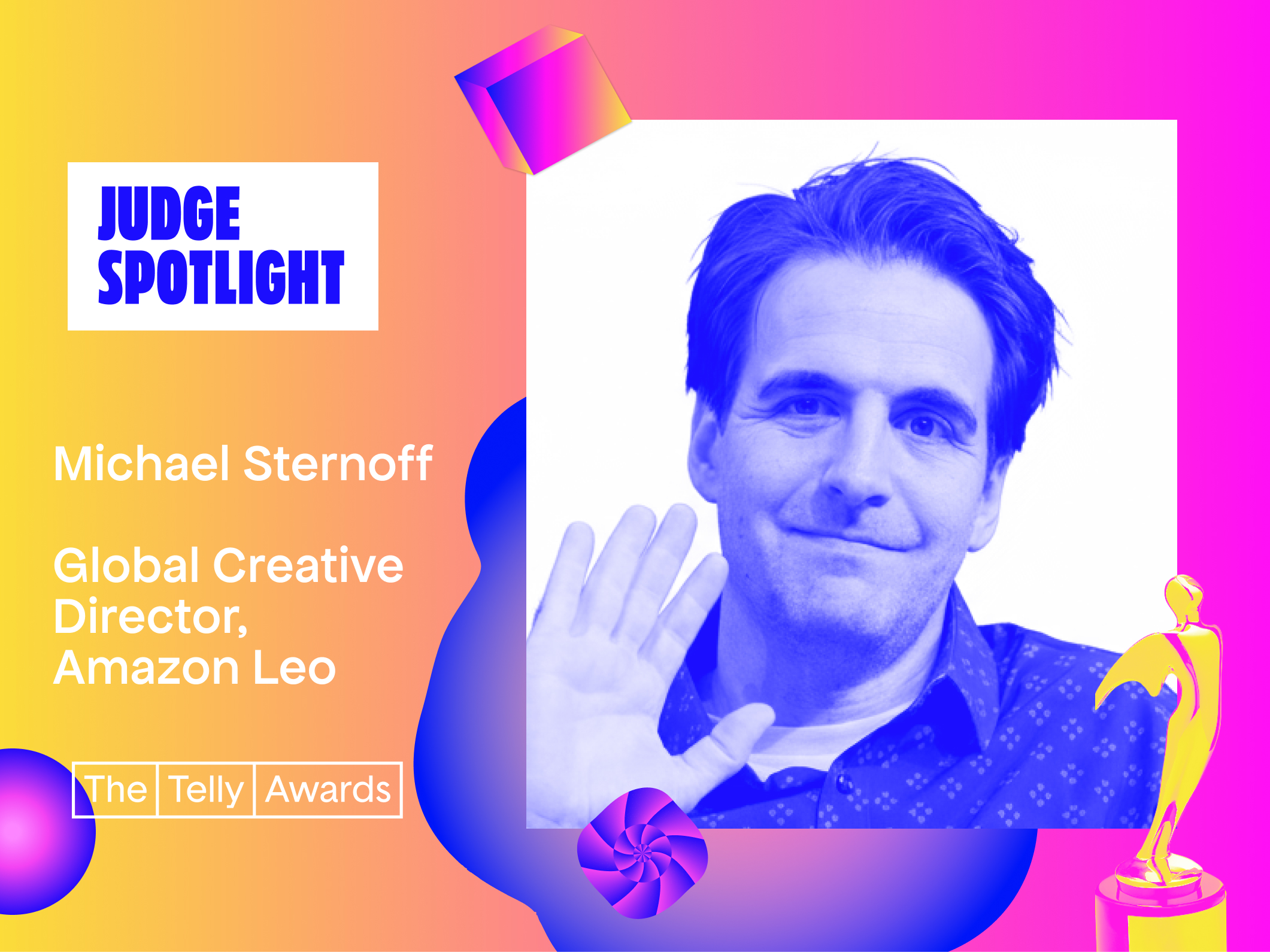
I lead brand and storytelling for Amazon’s Project Kuiper, helping launch one of the world’s most ambitious satellite internet services. I focus on making complex ideas simple, building creative systems that scale, and crafting content that earns trust. My background is in documentary and journalism, and I still approach most projects with that same curiosity and clarity. I care about the work, the people doing it, and what it all adds up to.
How many years have you been a judge?
This is my first year!
What excited you about judging for the Telly Awards?
To be able to see all the innovative ways folks are telling stories across the industry.
What was your first job in the industry? What did it teach you?
My first job was as a photojournalist and editor for CLTV, a 24-hour regional cable news station in Chicago. It taught me to move fast and tell the best story possible, even with limited resources. I learned that “we can’t do it” is never an excuse—every assignment is a chance to learn something new. Many people limit themselves by saying, “That’s not my job,” but I saw it differently: the more I could take on, the more I could grow. If they didn’t need a shooter one day but needed a truck op, I stepped in. That flexibility carried me forward.
I’m not defined by any one discipline or medium. I’m a storyteller, and that openness has helped me reinvent my career whenever the industry or economy shifted.
What project are you most proud to have worked on?
In 2011 I released a short documentary called Kindred, a reflection on my friend Kindra, who was diagnosed with cervical cancer before her 30th birthday. The film captured how she faced a terrible illness with strength and optimism, and how her blog became both a lifeline and a way to share her story. It was also a tribute to a friend who lived each day with kindness, making other people’s lives better. That project taught me the power of storytelling at its most personal and human level.
What’s the most challenging part about your job and/or the industry?
The times are a-changing, and this industry always does as well. It’s difficult to navigate a business that never stands still, but that’s also what makes it exciting. To keep up, you need the flexibility to adapt and the curiosity to learn what’s next. The real challenge is staying ahead of change, because people who lock themselves into one role or definition will get caught flat-footed when the industry shifts.
What do you look for to determine excellence in video?
There’s no single formula. It’s about how the tools, writing, tone, visuals, and story, work together. I look for balance, not just telling me something new, but making me feel something new.
What are your current roles and responsibilities and what do you love most about your job?
I get to tell the brand story from end to end. That can be as simple as designing a logo or as complex as producing a full documentary. What I love most is shaping a holistic story across mediums that connects with our audience and gives them a consistent sense of wonder and innovation.
What initiatives or projects are you working on now that excite you?
Last year we launched Amazon Leo.
Building a new Amazon sub-brand from the ground up has been an incredible experience and a ton of work. Not just a logo, but a full design system. The Aurora, our pattern system that signifies connection. Krypton, our color system. The motion principles. How it looks, how it moves, how it behaves across every touchpoint. What matters most to me is consistency. The brand should feel the same whether you’re watching a film, walking a trade show floor, or seeing it in a product demo. It has to flex across mediums and operate as a worldwide brand, but still feel cohesive. The launch film, Countdown, is especially close to me. We partnered with Droga5. Trey Edward Shults directed and Rodrigo Prieto shot it on 35mm. We wanted filmmakers who would bring a handcrafted look and feel. When you’re telling a story about advanced technology, it’s even more important our stories feel human.
Countdown set the emotional bar. Now the work is expanding that foundation and making sure that feeling holds everywhere the brand shows up. It’s also a surreal moment when you see the brand name and logo your team created, on the side of a rocket launching into space. There’s something unique about that. But I’m most excited to build the next phase of this brand with this incredible core group of marketers and creatives we assembled at Amazon Leo.
Do you have any specific practices you lean on to spark creativity?
For me, it’s two things. 1. Just time. I need space to zone out and not think about anything. Driving or walking clears my head. Dave Chappelle calls it “the trance,” that moment when your mind drifts and ideas start to form. That’s when I start working things out visually. More often than not it’s walking my dog. 2. Crossing-mediums. I pull creativity from everywhere. I like to mix mediums and borrow storytelling techniques from unexpected places, like using Thelma Schoonmaker’s editing style in a doc or a Spielberg-style zoom/tracking shot from Jaws in a video-game trailer. It doesn’t need to be limited to a single medium. It’s the mix of ideas that makes something entirely new.
What inspired you to pursue your career path?
I still remember when I was a kid and Pulp Fiction came out. I was probably way too young to watch it, but I remember that the VHS had bonus content with deleted scenes. In that, Tarantino broke down why he shot each scene, how he cut it, and what went into crafting the movie. Before that, I never really understood the craft or what went into telling stories. But seeing the storyteller and the intention behind the frame has driven me ever since.
In your experience, what is a significant change you are seeing happen in the video, television, and/or film industry, and what insight can you share about how to navigate it?
Since I started in broadcasting, companies have been consolidating nonstop, it’s all constant change.There are only two ways to deal with it: resist it or find new paths. Change is never easy, but the only real way forward is to stay flexible and keep learning. The way we tell stories today is completely different from five or ten years ago. The best way to navigate it is to keep adapting.
At the core, it’s still about telling a story that makes people feel something. Video has a unique power to connect emotionally with viewers. If you stay focused on how you want them to feel, you’ll always find a new story to tell.