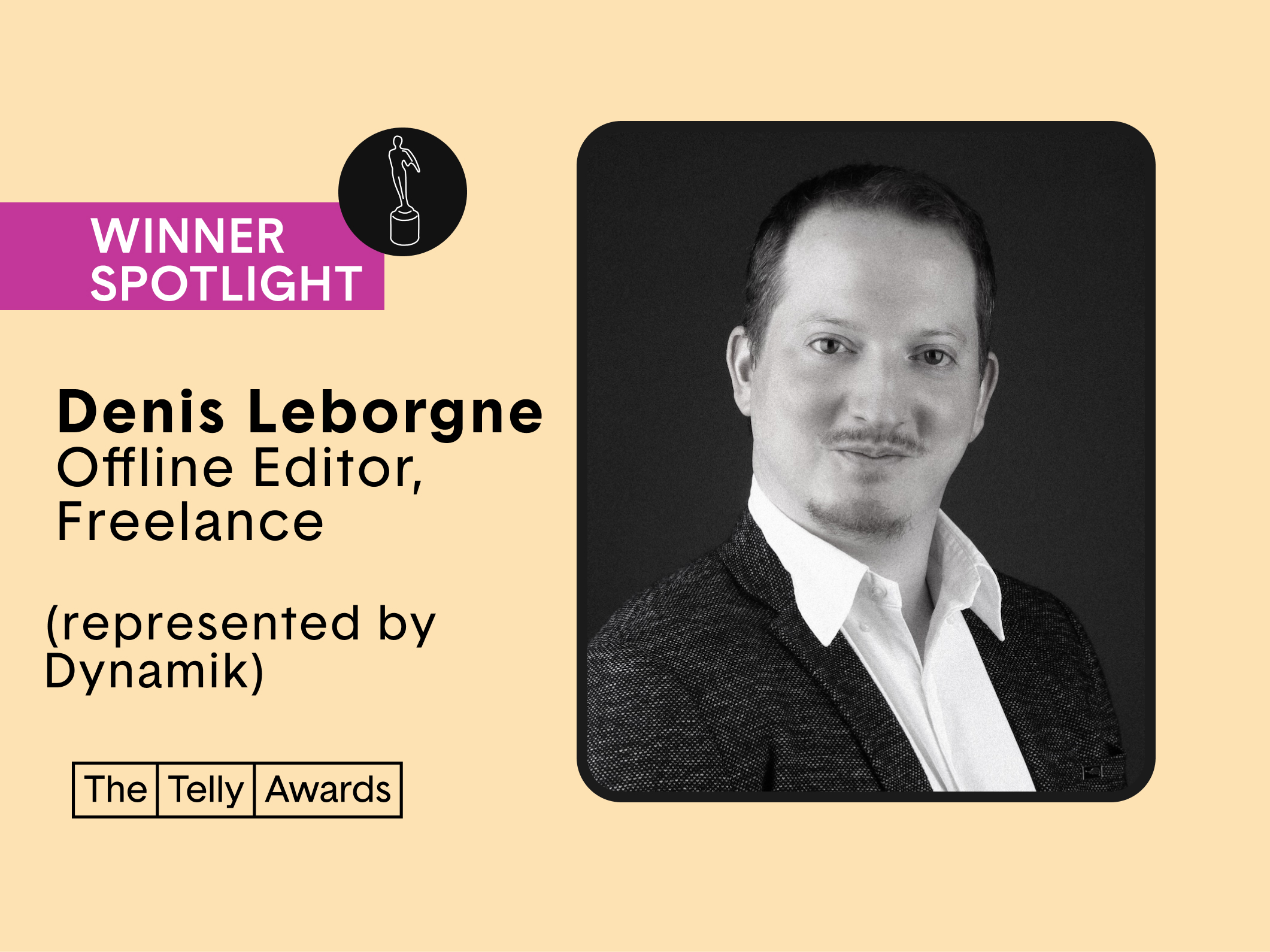
Tell us a bit about your organization and what your specialty is in the film and video space.
I’m represented by Dynamik, which is the MENA region’s premier post-production talent agency. It represents editors, colorists, sound designers, photo retouchers as well as a VFX studio (Mathematic) in the Middle East.
What is your organization’s ethos and how does it set you apart from industry competitors?
Dynamik is somehow a unique organization in the Middle East. It stands out by the quality of its people. I’m always amazed by what the other guys are doing, whatever their field is, and I definitely look up to Dynamik’s other editors (Rizwan Maple, Giacomo Prestinari, Fran Molina, Marcos Castiel, Oliver Don).
How can people join or learn more about what you do?
Nowadays, Instagram is my go-to channel of communication. It’s mostly serious work there, but I do drop a joke once in a while. For more extensive information, I also have a website: https://www.denis.film/
Tell us about your Telly Award winning piece. What’s the story behind it?
About “Liwa: The Desert’s Grand Stage” (Gold for Film Craft – Editing):
This film is somehow the antithesis of what is usually produced in the Middle East. Hats off to the client, and their agency, for daring a different approach.
A more poetic creative direction than usual, combined with production on real locations, without any CGI involved, paired with beautifully crafted shots by Gonzalo Oliveró and his DOP, Anatol Trofimov, all of that combined in a storytelling that doesn’t unfold within the first 5 seconds of the film, but over the entire length of it.
Then came the edit: first and foremost, we did a precise selection work to bring more than 19 hours of live-action footage down to a timeline of around 20 minutes. To achieve that, the dialogue between Gonzalo and me was key.
We don’t just delete more than 98% of the footage and keep less than 2% of what was shot in a simple, straightforward process: there are so many factors involved. Then, Gonzalo asked me to throw the shooting board into the trash bin. He knew how things could be done, but he was more interested in seeing if I could come up with ways to tell the story that he hadn’t thought of.
Giving that freedom to an editor is a risk, but one that can be hugely rewarding because it triggers creative freedom in the editor’s mind. It was no longer about following a pre-established formula, but about crafting the best approach to bring storytelling intentions to life.
About “101 Abu Dhabi Do’s – Adventures with Liu Yifei’s Summer Experiences!” (Silver for Film Craft – Editing):
This film was part of a bigger Experience Abu Dhabi Summer 2024 campaign in which multiple commercials were produced for different markets (global market, Indian market, etc.). This one, starring Chinese-American actress Liu Yifei, was intended for the Chinese market. These commercials had a common goal: to bring a “larger-than-life” feeling into the films.
We used 3D animation to transition from one location in Abu Dhabi to another, transforming our movie star into a sort of flying superhero! I was very lucky to work with Anh Vu, a director who works with a rare level of precision, and who had explored animation films before the start of our editing process. She had selected shots from pre-existing feature films to simulate those scenes in the edit and create the flow we needed more precisely, allowing for more accurate animation work from the studio By Fiction once the edit was locked.
We actually respected Anh’s initial plan quite closely for this edit (no storyboard sent to the trash bin on this one). But of course, multiple scenes required creative editing decisions to ensure we followed the character’s journey in the best way, while showing enough of the locations and featuring Liu Yifei in the most pleasant and enjoyable way.
Anh wanted this film to be in constant motion: even if Liu stopped for a moment, amazed by the location’s beauty or enjoying dinner with her friends, Anh used her visual language, helped by her DOP, Agustin Barrutia, to make sure the audience always felt a sense of movement and progression.
What are you most proud of about this piece? What was your biggest challenge during production and how did you solve it?
About Liwa: Time was against us. With the archives included, the total amount of footage reached 29 hours.
The film was far too ambitious for the time initially allocated. We made compromises to meet those non-negotiable deadlines.
The only option left was to return to the project later, to give this footage the respect it deserved and create a proper director’s cut.The film was eventually screened at the Dubai Lynx in April, where it received three awards (Cinematography, Editing, Sound design).
For me, seeing the director’s cut presented there was a profound mark of respect from everyone involved.
Do you have any advice to other filmmakers based on your career or your team’s approach to work?
There is an idea that I have constantly challenged since I started in the creative industry — something I’ve unfortunately heard too often: “Nobody cares about quality, nobody sees the difference.” Well, I do. And I believe the audience feels it much more than some people might think.
Just as you don’t need to be an engineer or a mechanic to know how great it feels to drive a good car after driving a bad one, the audience doesn’t need to be a professional to sense the difference — even if they can’t always explain it — when they watch a well-crafted film.
Therefore, I strongly believe in leveling up rather than lowering my standards. This mindset is what allows me to keep evolving. The advice is simple: don’t choose the easy route.
Can you share a behind the scenes story or fun fact about the making of your piece?
About Liwa: I couldn’t believe my eyes when I first discovered the footage. I even recorded my monitor as it played back and sent a clip to my post supervisor, Rafic Sawaya, just to show him a buggy’s exhaust spitting fire.
About 101 Abu Dhabi Do’s: Since Anh Vu is a director from New York, I expected to speak only in English with her. But once in the editing room, I discovered she was also French-speaking! As a Belgian from the southern part of the country, this is my native language.
Tell us about the most memorable response you got from this work.
Our first mission is to make films for the audience. Once we have delivered what we believe is the best we can do, it no longer belongs to us.
In Liwa’s case, seeing a lasting international impact beyond the UAE, for a few months, has definitely been the most memorable thing.
About 101 Abu Dhabi Do’s: I think seeing Liu’s fanbase go crazy about the film when it was released — and motivated to follow her path in Abu Dhabi — was probably the best response.
Complete this sentence: ‘Great video storytelling is…’
… not leaving the audience indifferent.