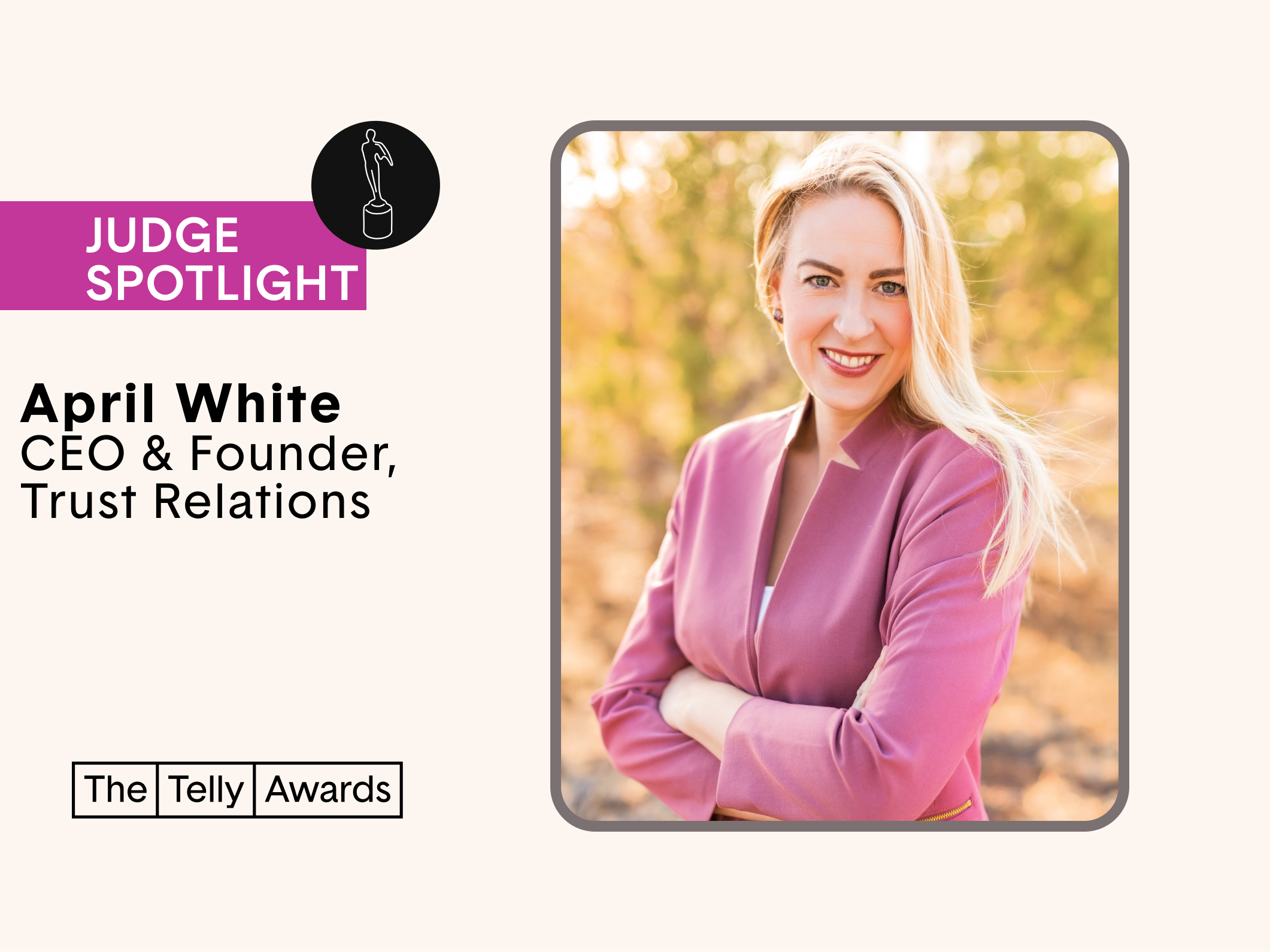
Trust Relations’ CEO, April White, founded the agency she wished existed after working for many legacy PR firms, which won a gold Stevie® Award for “Woman-Run Workplace of the Year–More than 10 Employees” in 2024. An official TEDx speaker, White also won a silver Stevie® Award for “Maverick of the Year–Advertising, Marketing & Public Relations in ‘23 and a gold Stevie® Award for Most Innovative Woman of the Year–Advertising, Marketing & Public Relations in ‘22.
How many years have you been a judge?
This is my first year!
What excited you about judging for the Telly Awards?
I am a PR professional with a love of film, TV, acting, and screenwriting, which I pursue in my free time. So, this is an exciting opportunity for me to apply my knowledge of everything I do for both my career and passion projects at the same time.
What was your first job in the industry? What did it teach you?
I began my career as a newspaper reporter, which taught me that I cared too much about what people thought to be a journalist. That’s when I knew PR was a better fit for me, so I could ensure my clients were happy. If you’re a good journalist, everyone hates you because you tell both sides of the story and everyone wants you to only tell their version.
What project are you most proud to have worked on?
I have represented several Fortune 100 companies, but I still find working with startups to be the most rewarding. There’s something extra satisfying about helping a new brand with a fresh vision that’s trying to carve out space and a name for itself within a competitive landscape find their voice on the world stage.
What’s the most challenging part about your job and/or the industry?
Public Relations is one of the most difficult forms of marketing when it comes to demonstrating a return on investment. If we get a client in The Wall Street Journal, Forbes, or TechCrunch, for example, it is difficult to prove how many sales that media placement drove. This is especially challenging in a down economy when money is tight, because every dollar spent must clearly generate sales that prove the investment was worth it.
What do you look for to determine excellence in video?
Great videos, as with great storytelling, show rather than tell. I look for innovative framing and camera angles that show a unique perspective or point of view that says something more; symbolism that conveys more than words ever could; a coherent message or theme that leaves viewers with a new take on something they’ve never considered before; and, ideally, a clear communication of something that the video wants viewers to relate to or better understand. Bonus points if the theme or overarching narrative delivers an insight or uplifting idea, even if it leans dark themeatically, because then viewers walk away uplifted rather than simply feeling misled, entertained without substance, or dragged through dark mud for no reason.
What are your current roles and responsibilities and what do you love most about your job?
As the CEO & Founder of Trust Relations, I oversee client service, operations, business development, and marketing. I love that this enables me to ensure my initial vision for the agency remains in tact and continues to evolve with the company.
What initiatives or projects are you working on now that excite you?
We are piloting a new offering that helps startups without solid messaging, positioning, or PR strategies by giving them a robust roadmap with samples of everything they need to scale their brand credibility–all within 45 days.
Do you have any specific practices you lean on to spark creativity?
Usually creative sparks come to me like Hemingway went broke: Gradually, then suddenly. I will have an idea that’s percolating and kicking around in my brain, and then there is a moment when the water breaks and the baby is coming–or here. I have come to recognize that it’s important to seize those moments and treat them as such. But it’s equally important to be patient with the creative process and let the ideas bake. Forcing them out too soon can compromise what the final product could have looked like, if given a little more time to congeal.
What inspired you to pursue your career path?
I have always loved to write. I wanted to be a screenplay writer, but my Midwestern parents thought that was an impractical career choice, so they encouraged me to go into journalism instead and do creative writing on the side. Journalism turned into PR, but I still write on the side and pursue my creative interests as hobbies that don’t need to pay the bills, which is nice. That ultimately gives me more freedom to express myself creatively without any commercial restrictions, compromises, or concerns.
In your experience, what is a significant change you are seeing happen in the video, television, and/or film industry, and what insight can you share about how to navigate it?
AI is making it easier for anyone to create videos or films with lower budgets. This will ultimately make it easier (or should) for artists with great ideas to produce them–even if that version only ends up being a proof of concept. AI can also help brainstorm creative ideas, which is fantastic. I once asked AI to write a poem that sounded like Khalil Gibran had a baby with Edward James Olmos, and it nailed it. It is important, however, to remember that AI can only recombine existing ideas and art, and only humans can truly invent new art forms and ideas. I think the artists who succeed in the coming decade will be those who use AI to make their concepts stronger but know that only they can truly create something new–and because the rest of the world is relying too heavily on AI, their work will stand out.